
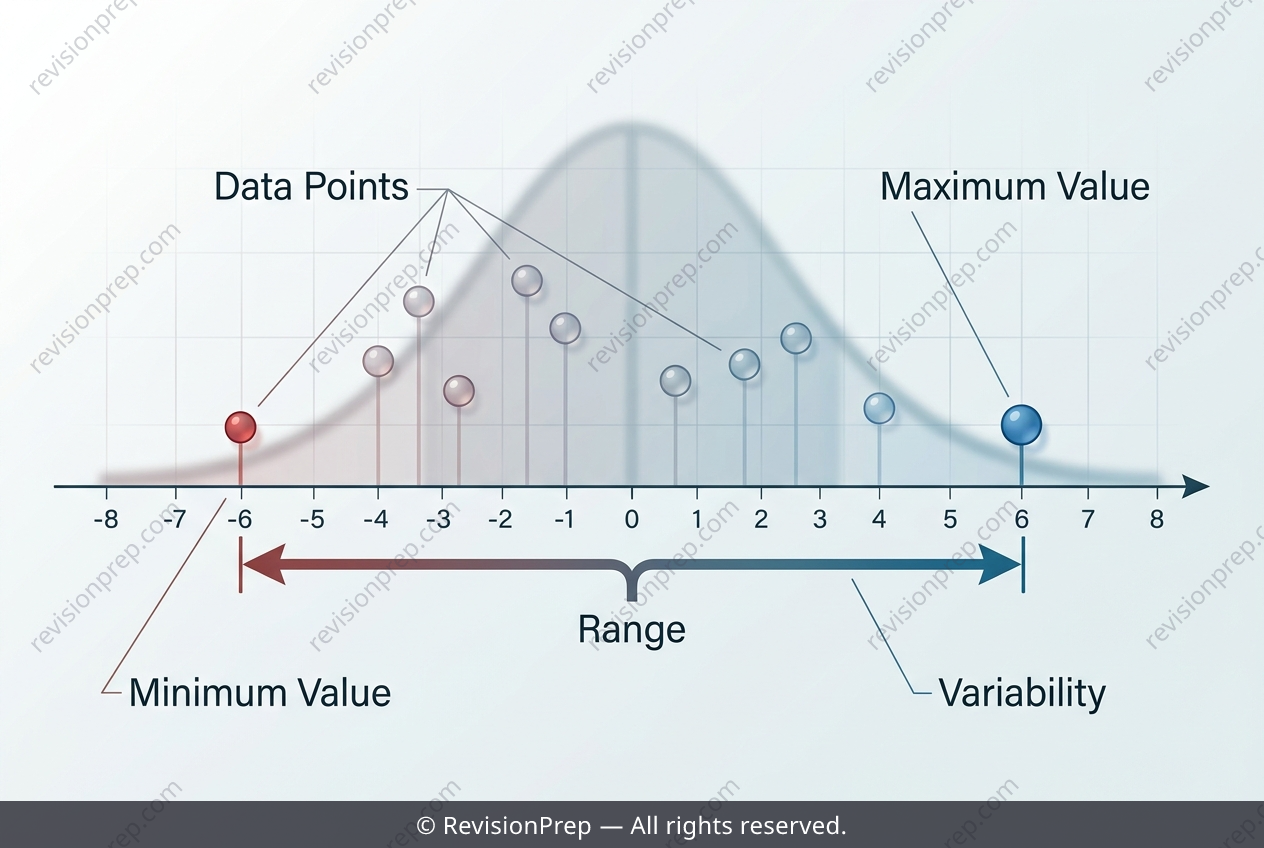
Maths: Why Range Is Sensitive to Just Two Points
Range is the simplest measure of spread: the distance between the smallest and largest values in a data set. On a dot plot or stem-and-leaf diagram, it captures how widely the observations are scattered along the number line, giving an immediate sense of variability where an average alone would hide it. The calculation rests on two connected steps. First, identify the maximum and minimum values, since these anchor the entire spread. Then subtract: Range = maximum − minimum. Both values must come from the same data set, and the subtraction must follow directly from them, so a correct method paired with a misread extreme still signals understanding of the underlying relationship. Because range depends only on two points, it responds sharply to outliers, making it a quick but sensitive indicator of how much a data set varies.
Start practising IB questions today
150,000+ IB-styled questions, criteria-mapped and instantly accessible.