
Chemistry: Particle Spacing, Motion and Phase Changes
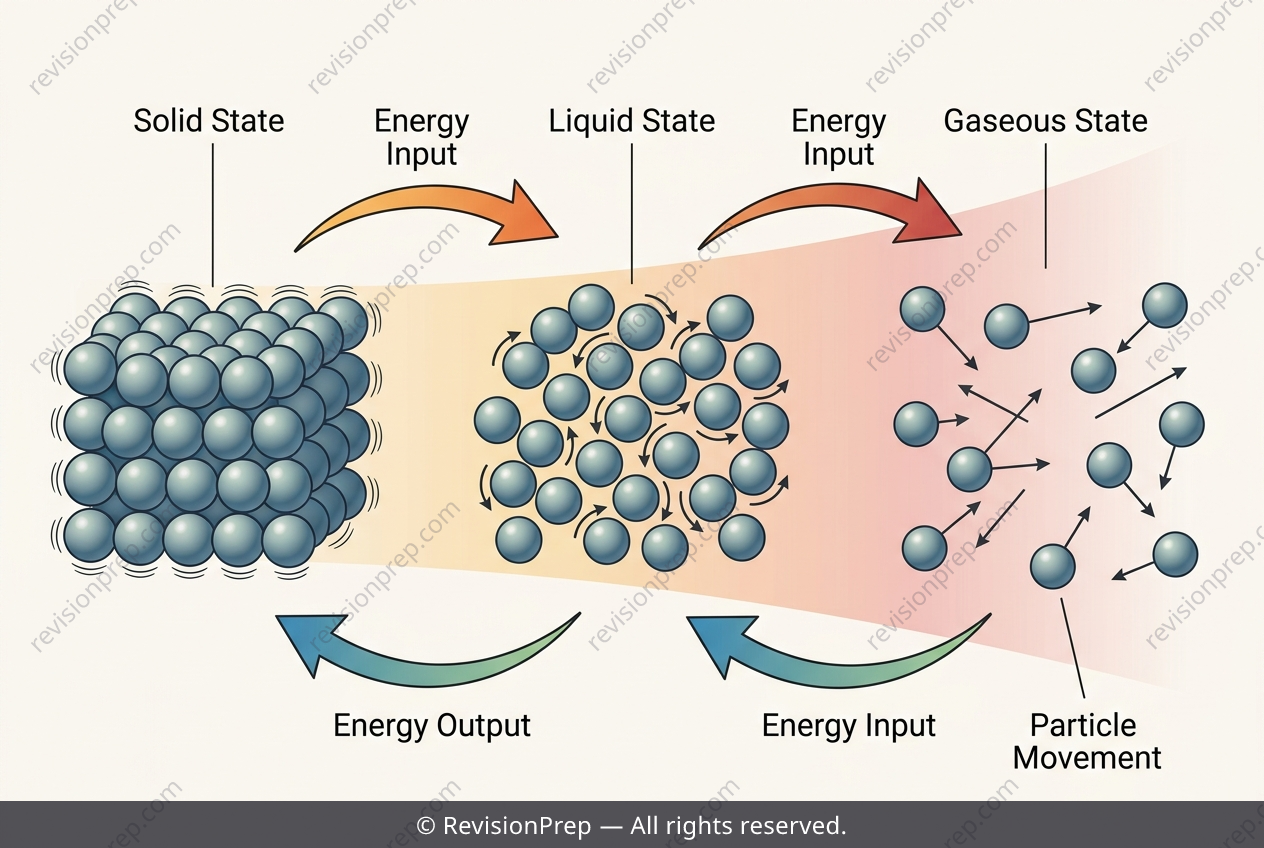
The Kinetic Particle Theory explains how the arrangement and movement of particles determine whether a substance exists as a solid, liquid, or gas. In the diagram, ice cubes (X) represent the solid state, where particles sit in a fixed lattice and vibrate about fixed positions, giving a definite shape. Liquid water (Y) has closely packed particles that can slide past one another, so it flows and takes the shape of its container. Steam (Z) consists of widely spaced particles moving rapidly and randomly, with negligible forces of attraction, allowing the gas to expand and fill available space. These differences matter because they underpin phase changes and the observable properties of everyday materials. As energy is added or removed, particles gain or lose kinetic energy, shifting the balance between attractive forces and motion, which drives melting, boiling, condensation, and freezing. Recognising how particle spacing, order, and movement connect across the three states provides the foundation for explaining density, compressibility, diffusion, and energy transfers during heating curves.
Start practising IB questions today
150,000+ IB-styled questions, criteria-mapped and instantly accessible.