
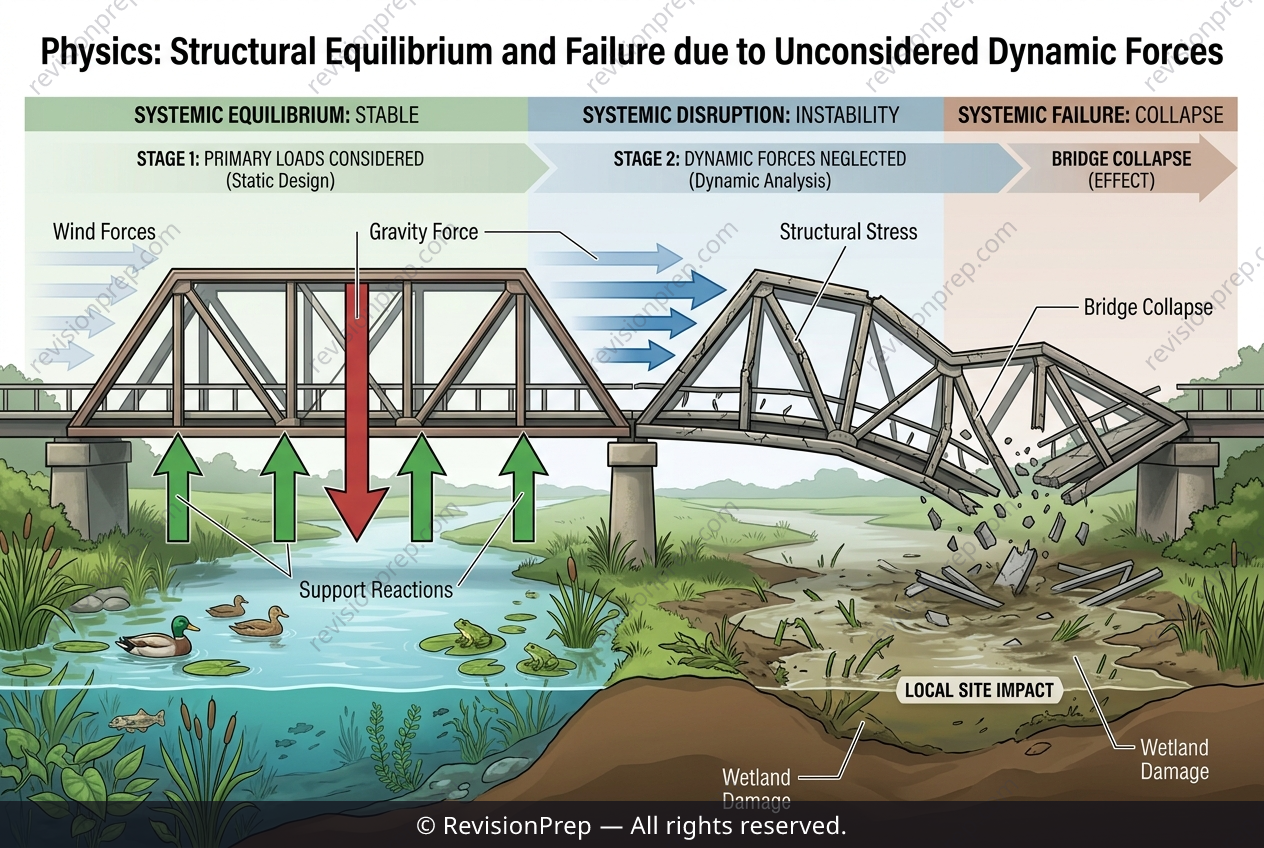
Physics: Structural Equilibrium and Risk of Ignoring Loads
Structural equilibrium is the condition in which all external forces acting on a body resolve to zero net force and zero net moment, keeping the structure stationary. A force diagram captures this balance by representing every applied load as a vector, so the weight of a bridge deck acting downward at its centre must be matched by upward support reactions at the piers. When a load such as wind is omitted, the diagram no longer reflects the true resultant force, hiding horizontal components, lateral bending moments, and shear forces along the deck. This matters because equilibrium analysis underpins real risk management in engineering. Wind loads add horizontal vectors that combine with vertical ones, so the actual resultant force has both greater magnitude and a different direction than the simplified diagram suggests. Ignoring them means maximum stresses and bending moments are underestimated, potentially causing lateral deflection, connection failure, and collapse — with consequences such as habitat destruction and chemical contamination of a wetland.
Start practising IB questions today
150,000+ IB-styled questions, criteria-mapped and instantly accessible.