
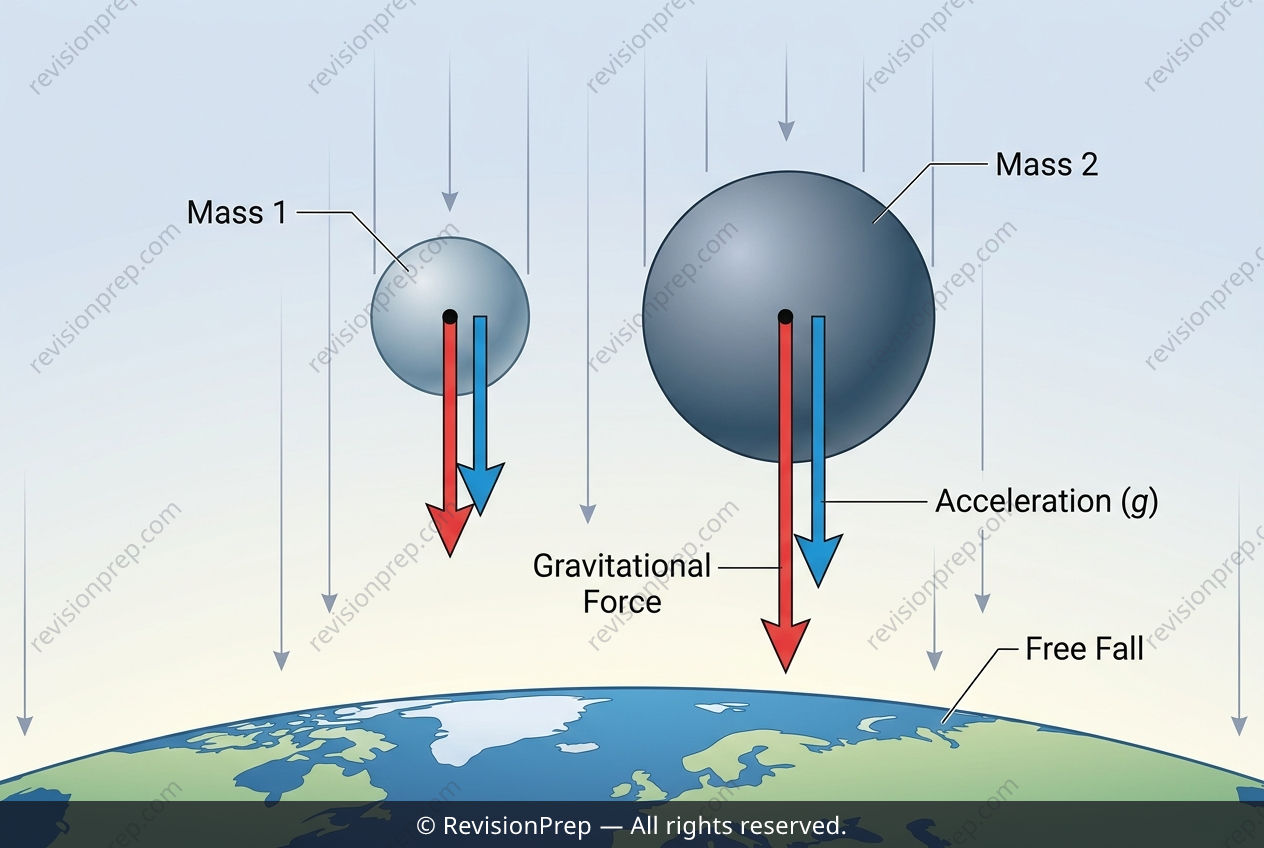
Physics: Why All Objects Fall at the Same Rate
Free fall describes the motion of an object where the only force acting on it is its weight — the gravitational pull toward Earth. At the instant a skydiver steps out of a stationary helicopter, gravity alone governs their motion, and Newton's second law, F = ma, links that downward force to the resulting acceleration. Since weight itself equals mg, the two ideas combine into a single, elegant relationship: a = mg/m = g. This matters because it reveals something counterintuitive: every freely falling object accelerates at the same rate, regardless of its mass. A heavier skydiver experiences a larger gravitational force, but also has proportionally more inertia to overcome, so the mass cancels completely. Understanding this equivalence — between gravitational force, mass, and acceleration — is central to mechanics, and it underpins why objects as different as a coin and a feather fall identically in the absence of air resistance.
Start practising IB questions today
150,000+ IB-styled questions, criteria-mapped and instantly accessible.