
Physics: Testing Momentum Conservation With Uncertainty
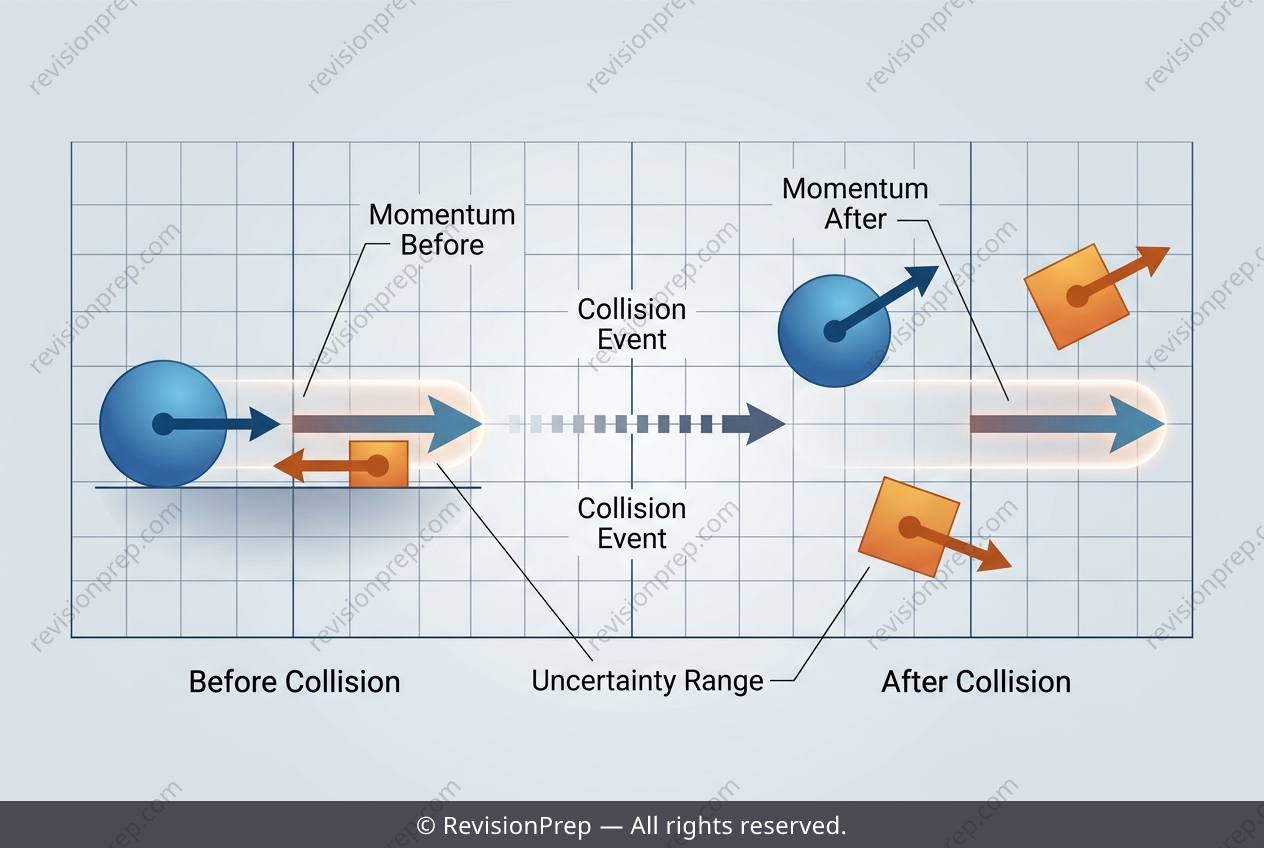
Momentum is a conserved quantity: in a closed system with no net external force, the total momentum after a collision equals the total momentum before it, so pafter = pbefore. Plotting pafter against pbefore therefore turns this physical law into a straight line through the origin, whose gradient is the ratio pafter / pbefore. A gradient of exactly 1 is the signature of conservation — it shows that no momentum is gained or lost during the collisions. Real experiments never reproduce a perfect line, though, so each data point carries uncertainty, here error bars of ±5% on both axes. These define a rectangular uncertainty region around every measurement. If the line pafter = pbefore passes within all of these regions, the scatter reflects experimental uncertainty rather than a genuine breakdown of the law. This is how theory and measurement connect: the ideal relationship predicts the gradient, while uncertainty analysis decides whether the data actually support it.
Start practising IB questions today
150,000+ IB-styled questions, criteria-mapped and instantly accessible.