
Physics: Testing Newton's Third Law With Impulse
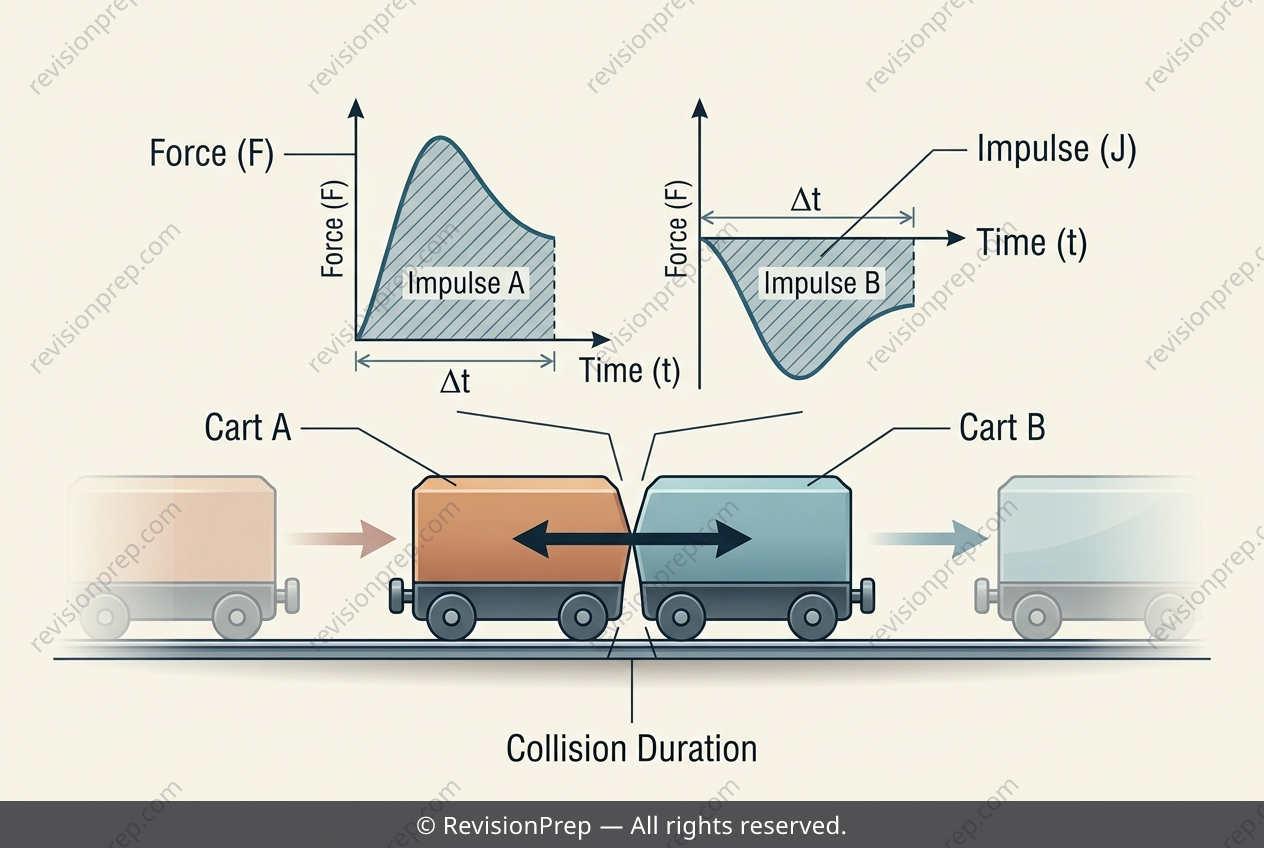
When two carts collide on a frictionless track, the interaction is governed by two linked ideas: the impulse–momentum theorem and Newton's Third Law. Impulse, the product of force and contact time, equals the area under a force–time graph — for a triangular profile, J = ½ × base × height. This tells us how much momentum is transferred during the collision. Newton's Third Law explains why that transfer is symmetric: the force Cart A exerts on Cart B is equal in magnitude and opposite in direction to the force Cart B exerts on Cart A. Since both carts share the same contact duration, equal and opposite forces must produce equal and opposite impulses. The force–time data therefore offers a direct test of the Third Law, while also revealing practical limits — sensor response times can distort the recorded triangle, making impulses appear unequal even when the underlying physics is perfectly symmetric.
Start practising IB questions today
150,000+ IB-styled questions, criteria-mapped and instantly accessible.