
Physics: Hooke's Law and Vehicle Suspension
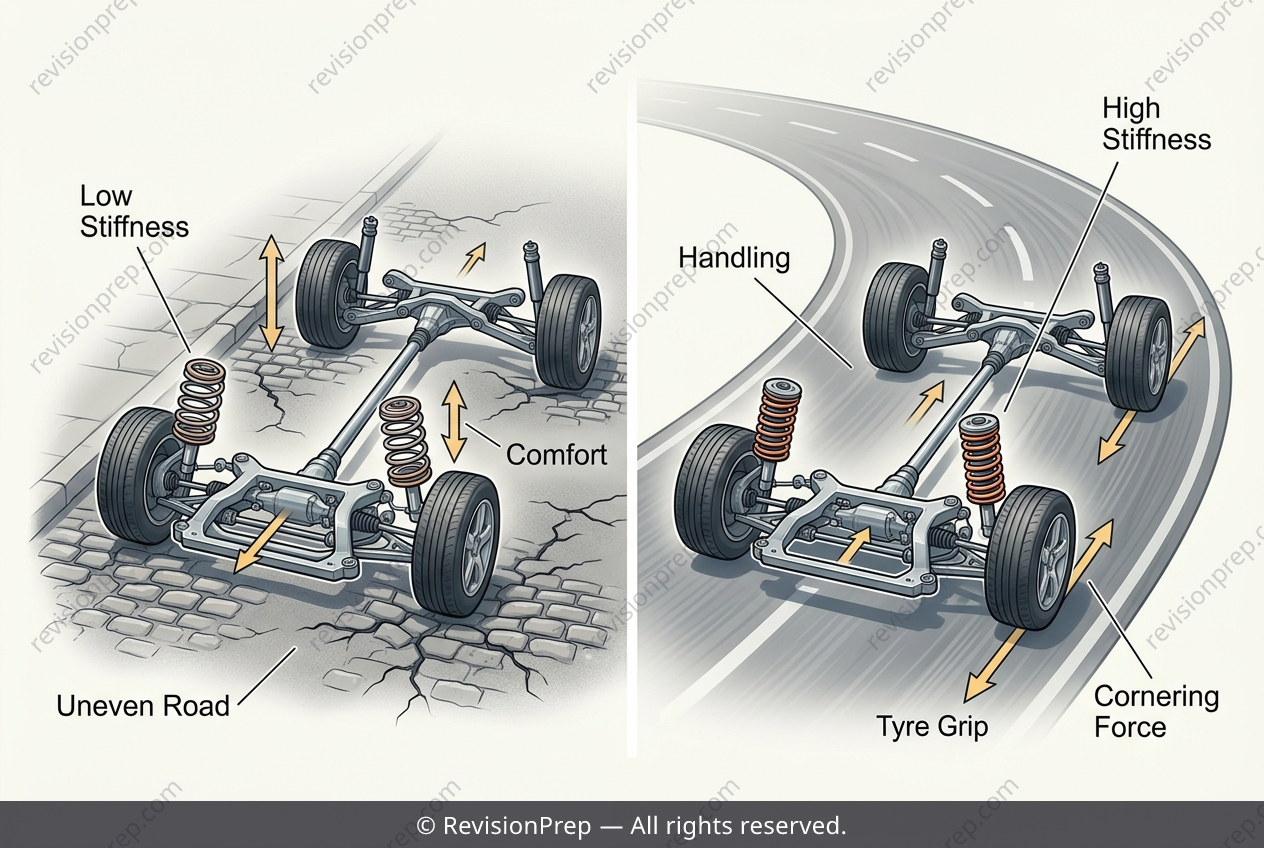
Hooke's Law, F = kx, describes how a spring responds to an applied force: the extension or compression x is proportional to the force F, with the spring constant k setting how stiff the spring is. A larger k means the spring resists deformation more strongly, so a greater force is needed to produce the same compression. This matters because a car's suspension springs are constantly balancing two competing jobs. During cornering, lateral forces push the body sideways, and stiffer springs generate larger restoring forces that keep the car level, reducing body roll and sharpening handling. On uneven urban roads, however, that same stiffness transmits more vibration to occupants, so comfort suffers. The engineer's task is therefore one of optimisation: choosing a k that delivers control on smooth motorways without making rough roads unbearable, since handling and ride quality pull in opposite directions as stiffness increases.
Start practising IB questions today
150,000+ IB-styled questions, criteria-mapped and instantly accessible.