
Physics: Why Paired Forces Produce Two Separate Motions
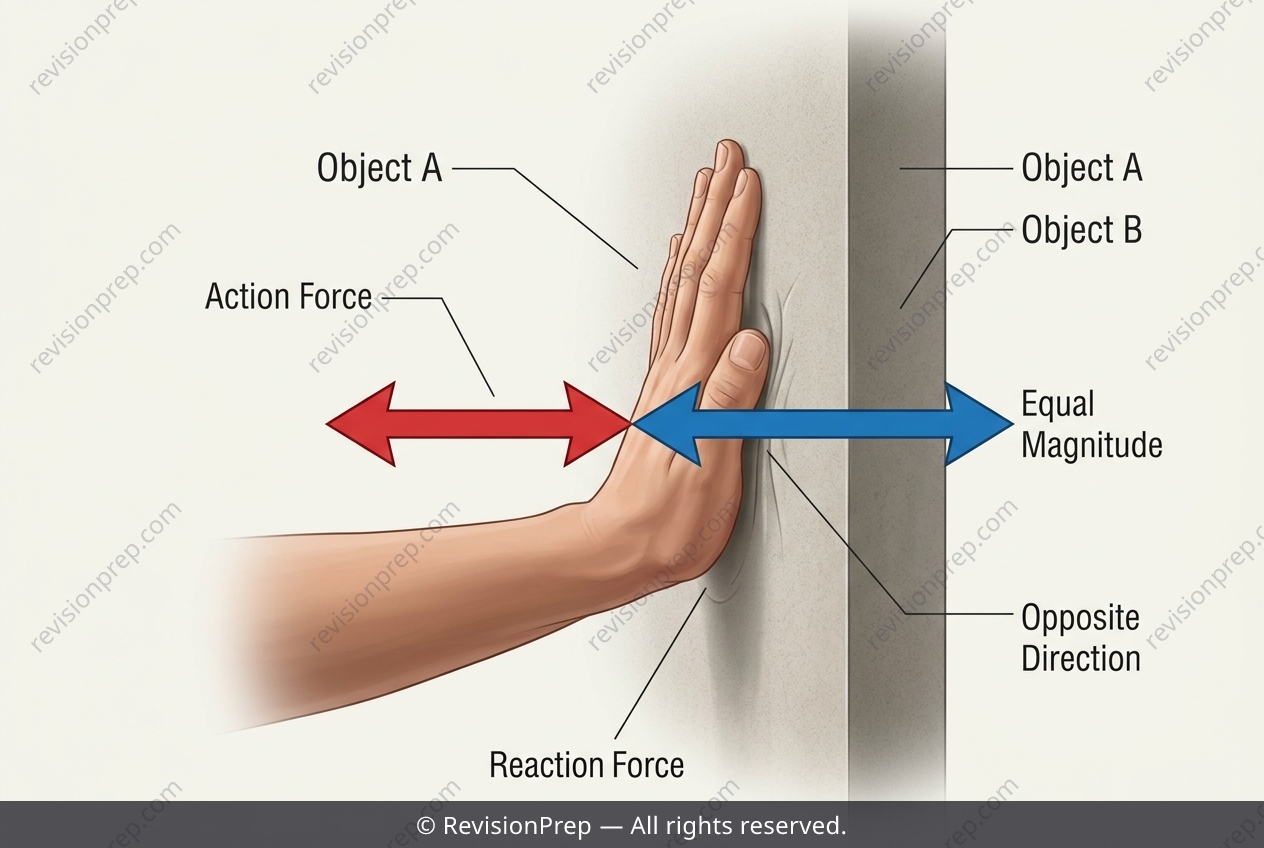
Newton's Third Law states that when object A exerts a force on object B, object B exerts a force on object A that is equal in magnitude and opposite in direction. These paired forces always act on different objects, which is why they never cancel each other out. In a collision, the ball pushes down on the sensor while the sensor pushes up on the ball, forming an action–reaction pair. This matters because it explains how forces arise in every interaction, from a dropped ball to a rocket launch. Crucially, the two forces stay equal at every instant, not just at the peak. If the graph shows the ball exerting 12 N downward at t = 0.2 s, the sensor simultaneously exerts 12 N upward on the ball. Since each force acts on a different object, each object experiences its own net force and its own resulting motion.
Start practising IB questions today
150,000+ IB-styled questions, criteria-mapped and instantly accessible.