
Biology: How Niche Differentiation Enables Coexistence
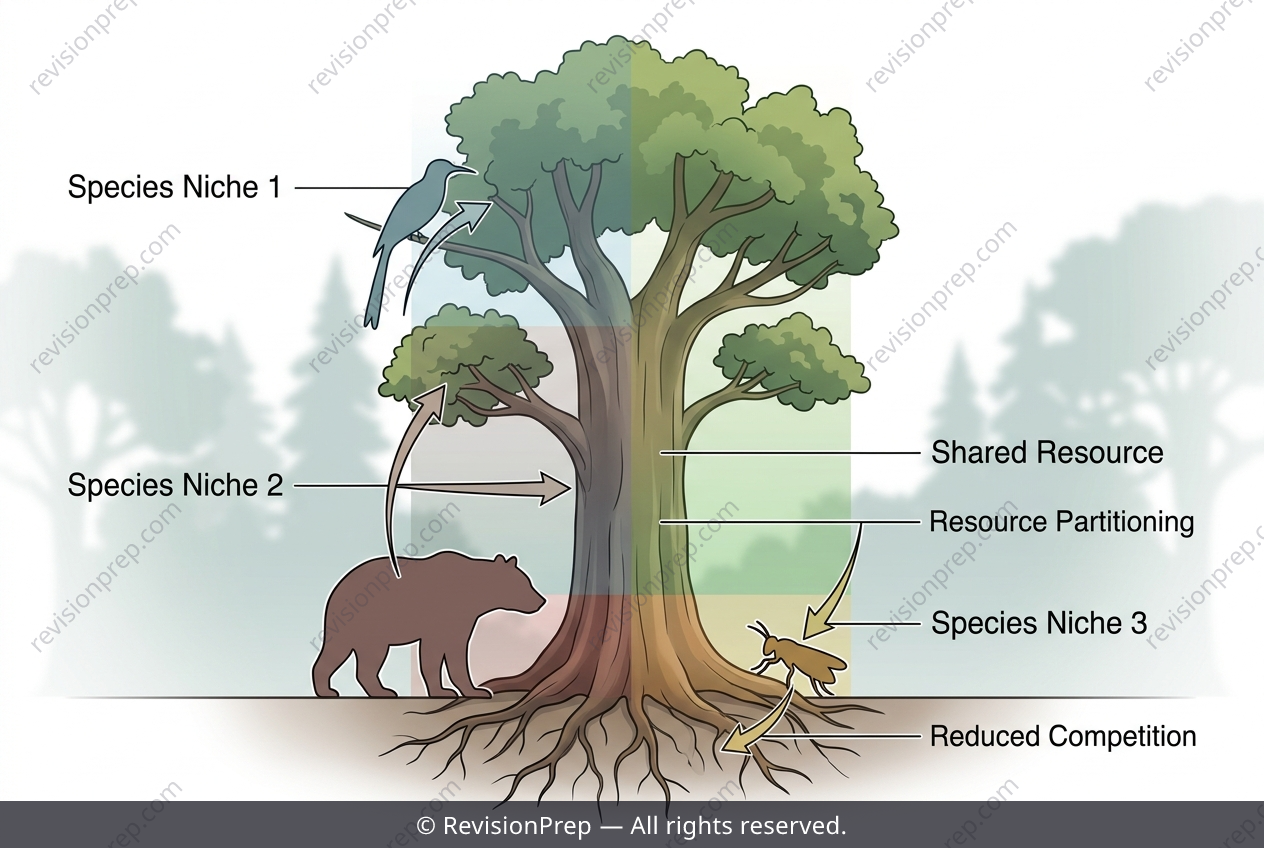
Niche differentiation explains how species that need the same resources can still coexist. Every organism occupies a niche — the full set of conditions and resources it uses — and when niches overlap heavily, interspecific competition intensifies, since individuals of different species compete for the same limited food, space, or time. Left unchecked, competitive exclusion predicts that the stronger competitor will eventually eliminate the weaker one. Niche differentiation, or resource partitioning, resolves this by splitting shared resources along niche dimensions such as space, time, or diet. In the salt marsh example, three wading birds hunt the same small fish yet divide the habitat by water depth and tidal timing: deep water at high tide, shallow water at low tide, and muddy banks exposed only during spring tides. Because each species forages in a distinct place and moment, overlap in resource use shrinks, interspecific competition weakens, and stable coexistence becomes possible.
Start practising IB questions today
150,000+ IB-styled questions, criteria-mapped and instantly accessible.