
Biology: Why Blocking Sodium Channels Silences Neurons
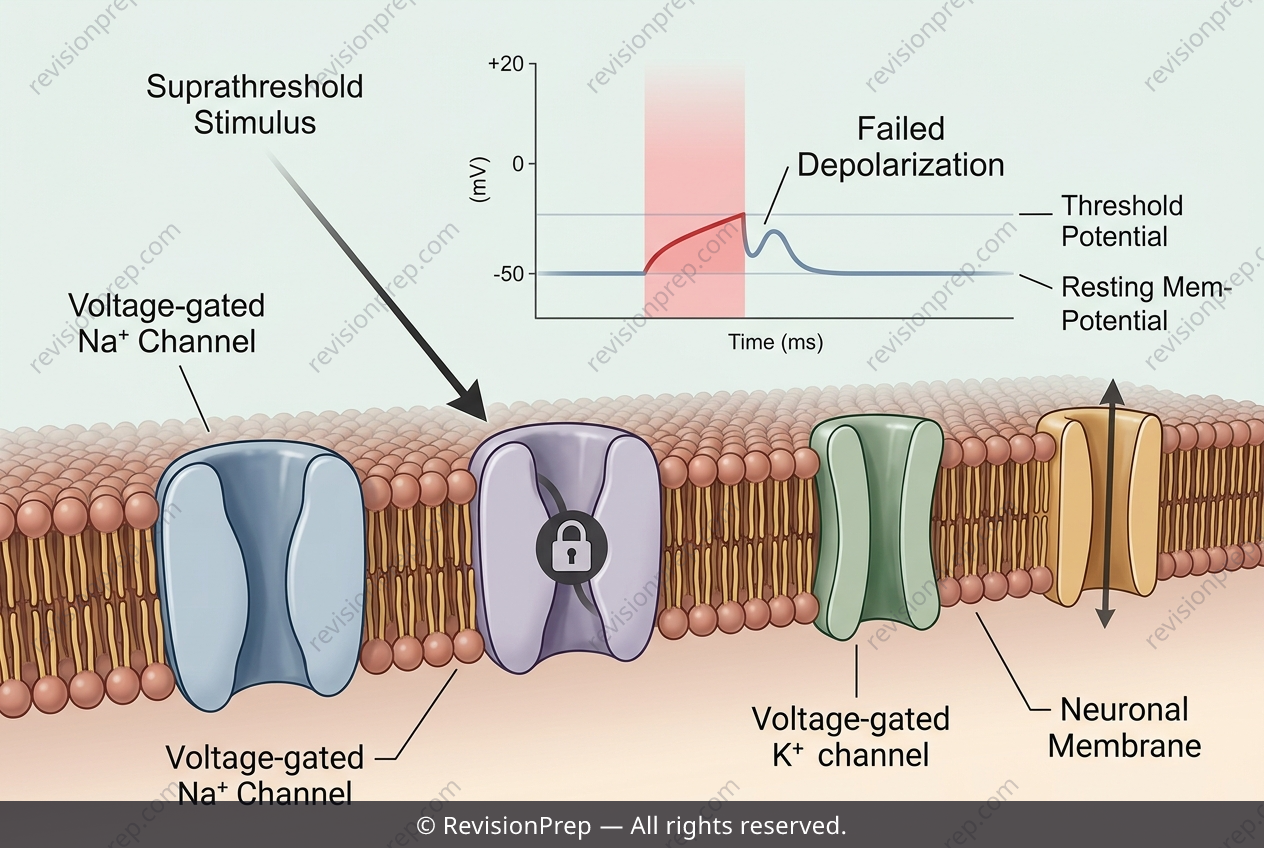
Every neuron maintains a resting potential, typically around −70 mV, and relies on precise ion movements to transmit signals. The action potential begins when a stimulus pushes the membrane to threshold, triggering the opening of voltage-gated sodium channels. These channels drive the rapid depolarisation phase, as Na⁺ ions flood inward and the membrane potential surges toward positive values. This moment is the foundation of neural signalling, converting chemical and electrical gradients into a travelling impulse. The mechanism depends on a strict sequence: threshold must be reached before voltage-gated Na⁺ channels open, and their opening must be fast enough to produce the inward current that sustains depolarisation. If these channels are blocked entirely, that rapid influx cannot occur, so the membrane never reaches the threshold needed to fire. Understanding this relationship clarifies why normal action potential amplitude and propagation depend absolutely on functional voltage-gated sodium channels.
Start practising IB questions today
150,000+ IB-styled questions, criteria-mapped and instantly accessible.