
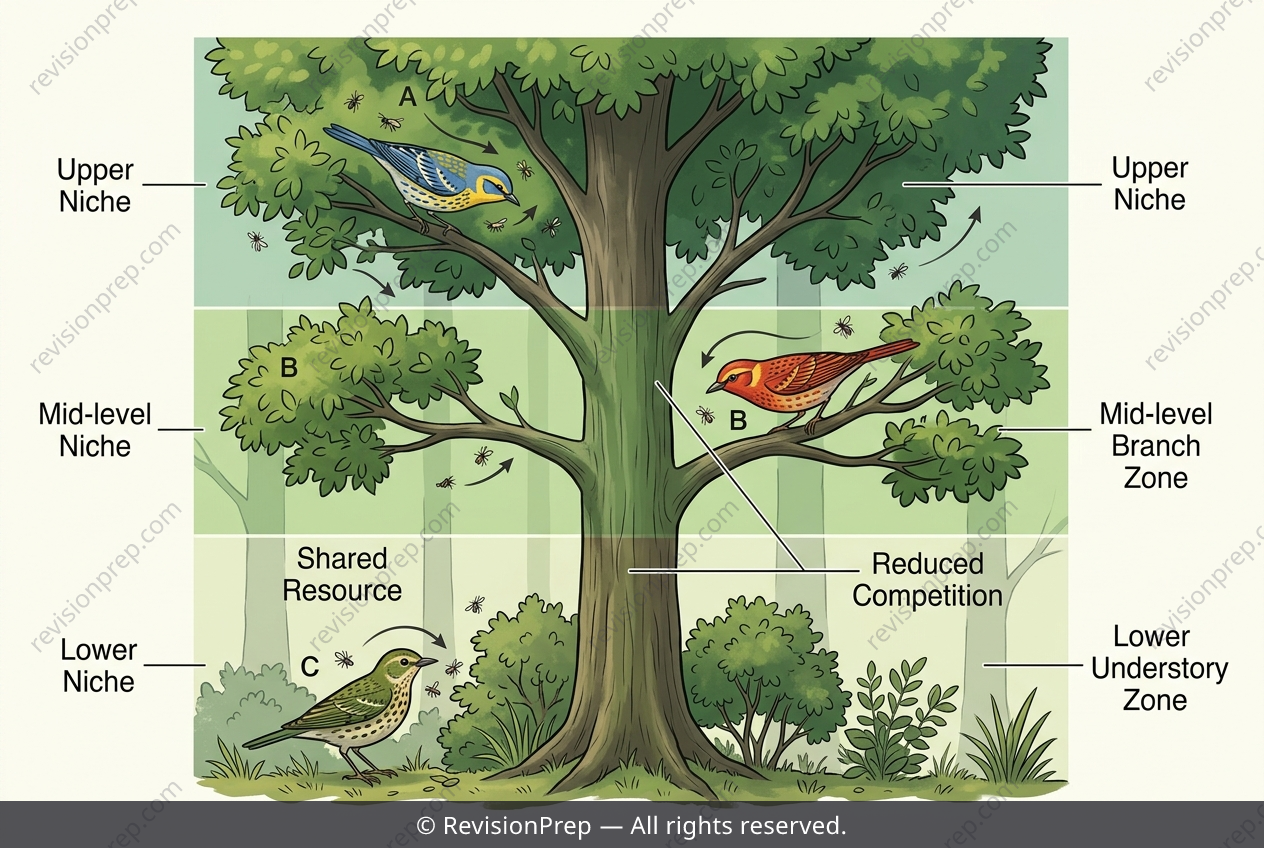
Biology: Why Less Niche Overlap Means Coexistence
Resource partitioning explains how ecologically similar species can share a habitat without one driving the other to extinction. When two species compete for the same limited resource, interspecific competition intensifies, and competitive exclusion becomes a real risk. Coexistence therefore depends on niche differentiation — the process by which species divide resources so that their realised niches overlap less. In the forest canopy, warblers illustrate this neatly. Species A forages in the upper canopy while Species B stays in the lower understory, so although both eat similar insects, they exploit different vertical zones. This spatial separation reduces interspecific competition, allowing both populations to persist. The key relationship is straightforward: greater niche overlap means stronger competition, while reduced overlap through resource partitioning supports stable coexistence. Understanding this mechanism matters because it links competition, niche theory and biodiversity — explaining why ecosystems can support many similar species rather than a single dominant one.
Start practising IB questions today
150,000+ IB-styled questions, criteria-mapped and instantly accessible.