
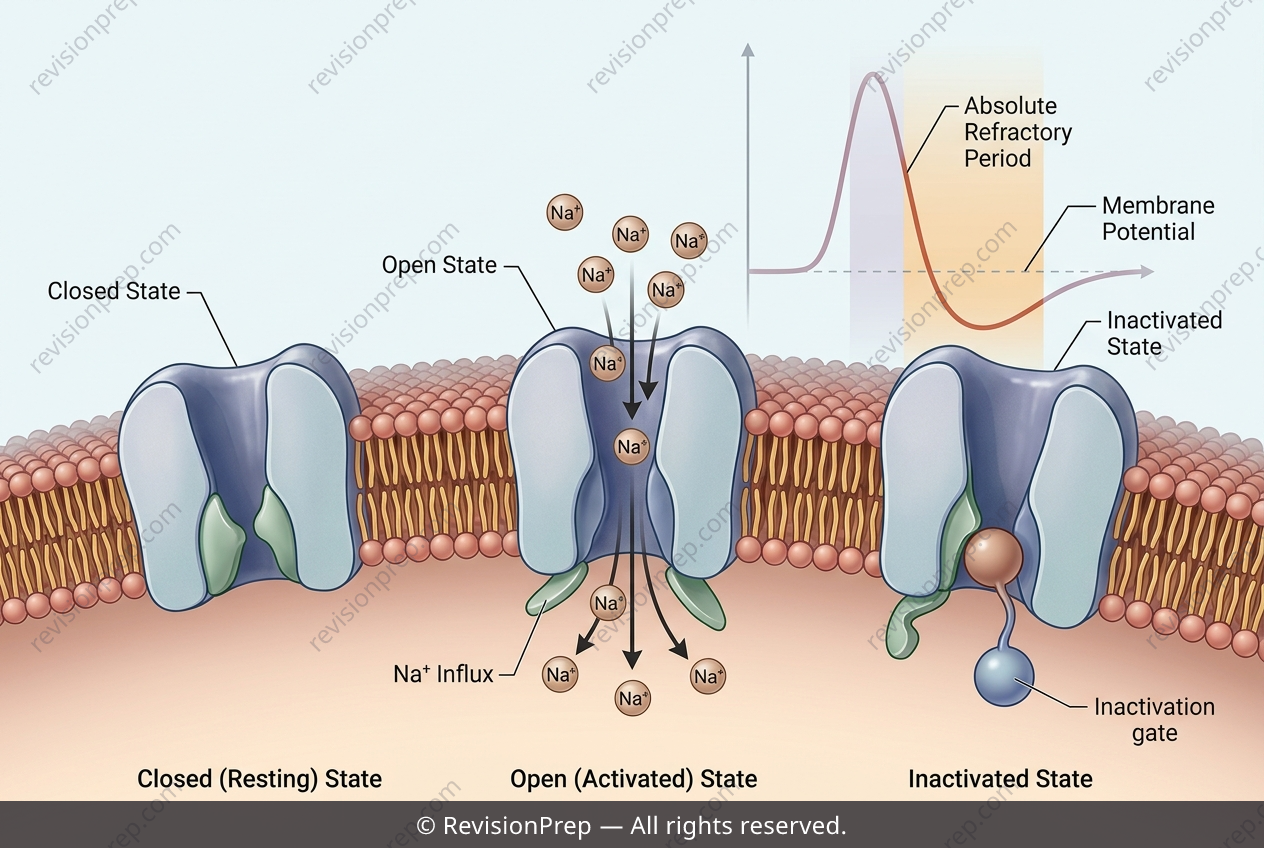
Biology: Why Channel State, Not Stimulus Strength, Sets Limits
Every action potential depends on voltage-gated sodium channels cycling through three distinct conformational states: closed (resting), open (active), and inactivated. These states are not interchangeable — an inactivated channel is structurally different from a closed one. Though both are shut, only the closed channel can reopen in response to depolarisation. This distinction underpins the absolute refractory period, the brief window during which no stimulus, however strong, can trigger a second action potential. It matters because it enforces one-way impulse travel along an axon and caps the maximum firing frequency of a neuron. The mechanism hinges on timing. After opening, sodium channels spontaneously inactivate, and they cannot reset until the membrane repolarises sufficiently. Potassium efflux drives that repolarisation, restoring the resting potential and allowing channels to return to their closed, excitable state. This sequence — inactivation, repolarisation, recovery — links channel conformation directly to membrane voltage. Understanding it clarifies why the refractory period is absolute rather than relative, and why channel state, not stimulus strength, sets the limit.
Start practising IB questions today
150,000+ IB-styled questions, criteria-mapped and instantly accessible.