
Biology: Why Lung Damage Starves Every Cell
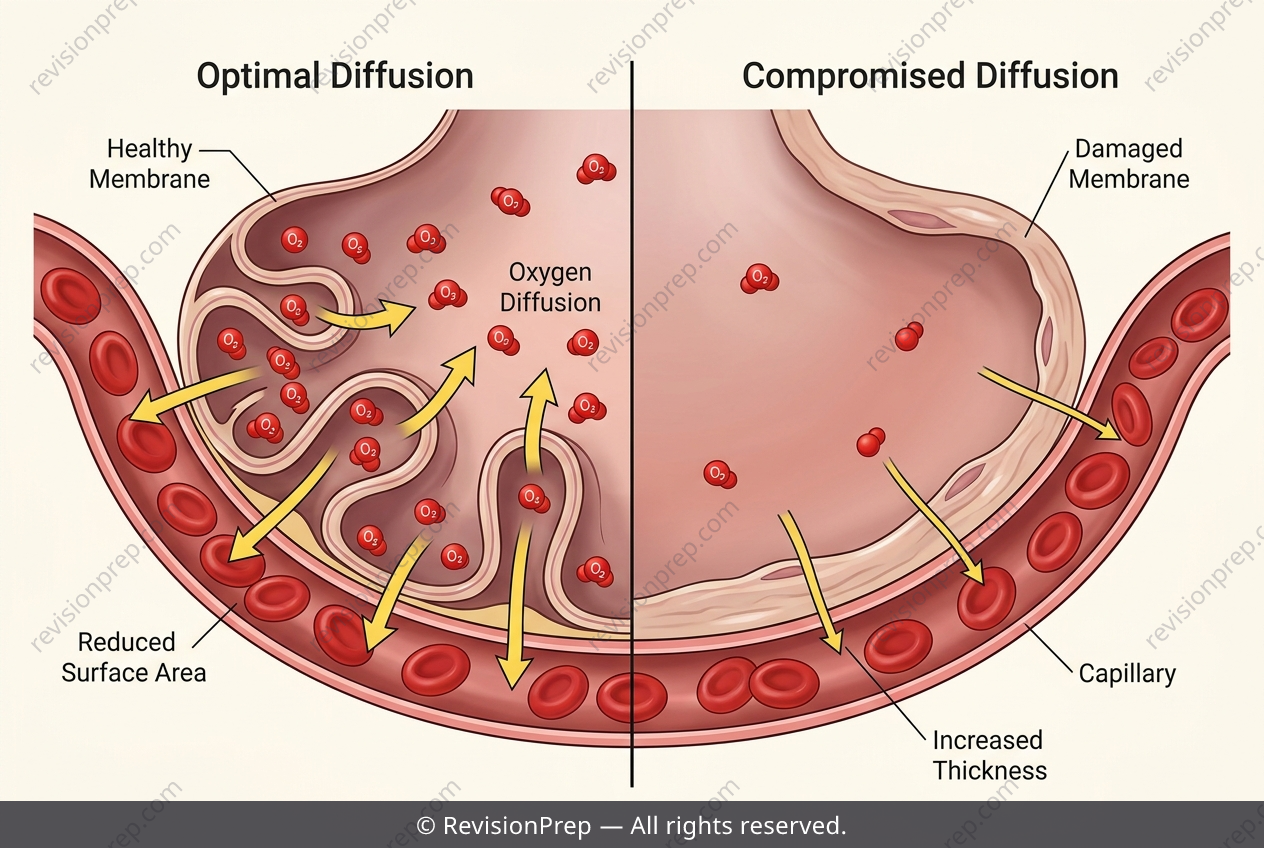
Alveolar gas exchange depends on a simple physical relationship: gases move passively from regions of higher partial pressure to lower partial pressure across the thin alveolar–capillary membrane. Fick's law captures this, stating that diffusion rate is proportional to surface area and the concentration gradient, and inversely proportional to membrane thickness. In healthy lungs, millions of alveoli provide an enormous surface area, allowing oxygen to diffuse rapidly into pulmonary capillaries and bind haemoglobin for transport to body cells. When alveolar structure is damaged, as in emphysema, that surface area falls, so the diffusion rate of oxygen into the blood decreases directly. Less oxygen entering the capillaries means less is delivered to respiring tissues, impairing aerobic respiration. This illustrates how form and function are inseparable in the respiratory system: the lung's architecture exists specifically to maximise diffusion, and any disruption to that structure has immediate physiological consequences for every cell in the body.
Start practising IB questions today
150,000+ IB-styled questions, criteria-mapped and instantly accessible.