
Biology: Why Overlapping Niches Cause Exclusion
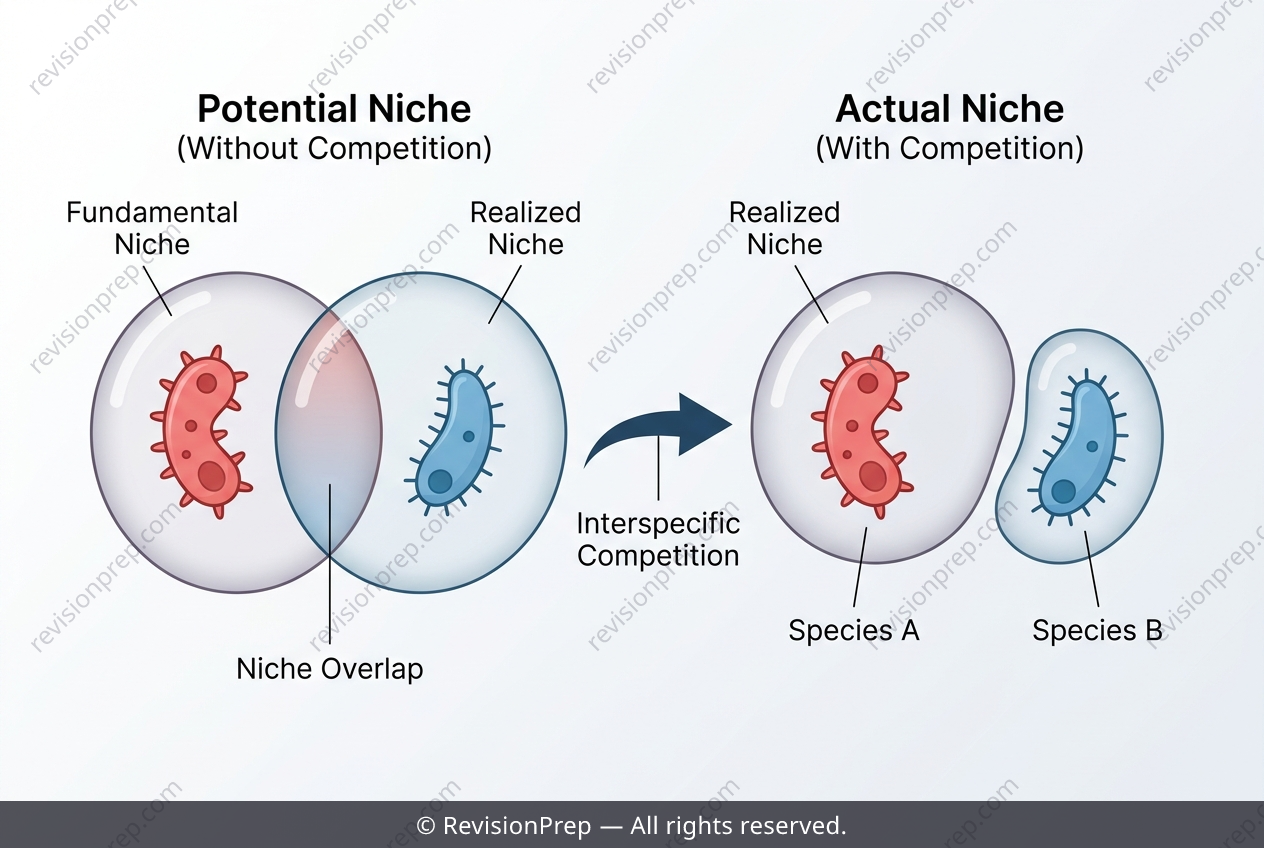
Competitive exclusion and niche partitioning explain why two species competing for the same limiting resource cannot coexist indefinitely. Gause's Paramecium experiments offer the classic demonstration: grown alone, both P. aurelia and P. caudatum reach their carrying capacity, showing that each can survive on the available bacteria. This reveals overlapping fundamental niches — the full range of conditions and resources a species could theoretically use without competition. When cultured together, however, P. aurelia persists while P. caudatum is eliminated. The shared food source becomes a contested resource, and the superior competitor drives the other's realized niche — the portion actually occupied under interspecific competition — down to zero. The concept matters because it links population dynamics to community structure: where niches overlap too heavily, competitive exclusion follows, while coexistence requires some degree of resource partitioning. Understanding this distinction between fundamental and realized niches is central to explaining biodiversity and species distribution in ecosystems.
Start practising IB questions today
150,000+ IB-styled questions, criteria-mapped and instantly accessible.