
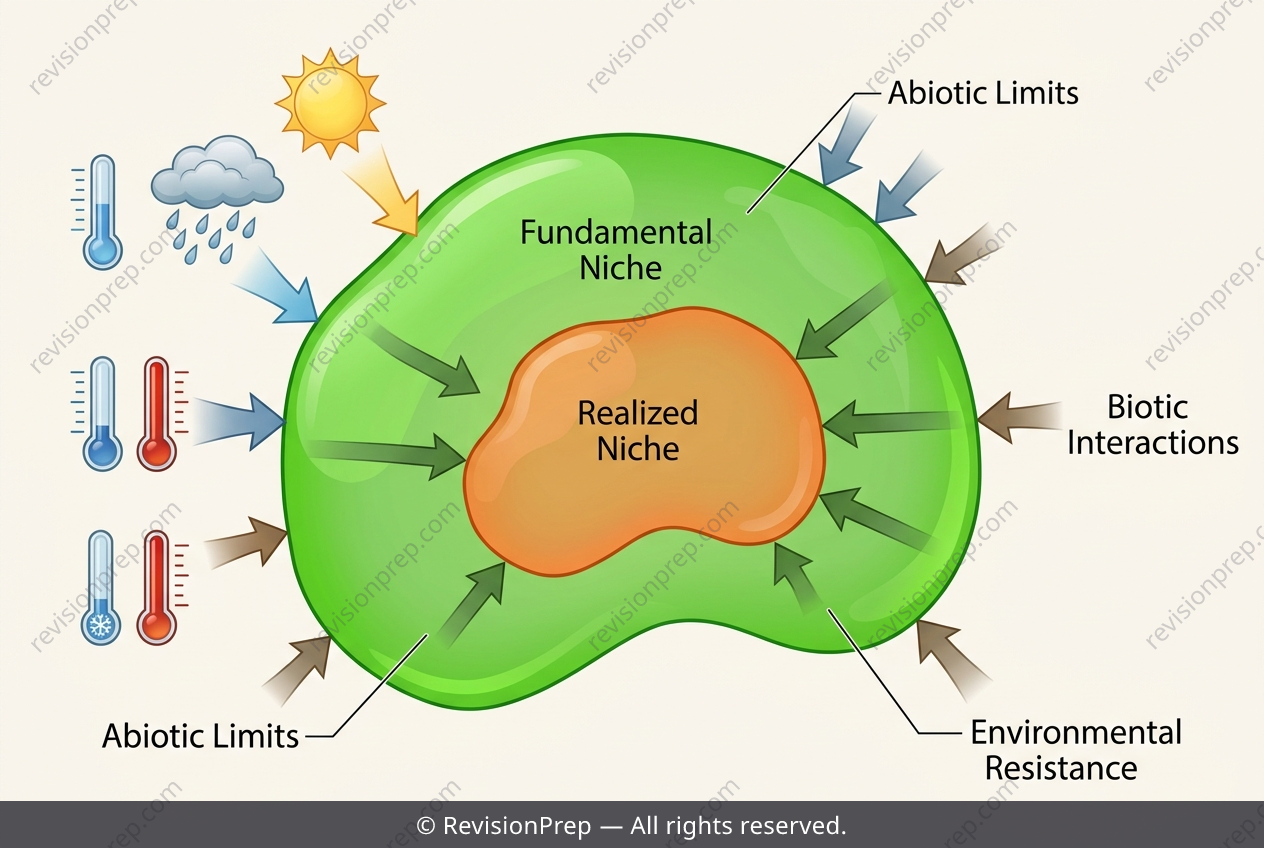
Biology: Why Rainfall and Predators Constrain a Niche
Every organism occupies a niche shaped by both its biology and its surroundings. The fundamental niche describes the full range of abiotic and biotic conditions under which a species can survive and reproduce, while the realized niche is the smaller subset it actually occupies once competition, predation, and other biotic interactions come into play. The gap between the two reveals how strongly living factors constrain a population. The cane toad in Australia illustrates this beautifully. Its native South American range defines a broad fundamental niche across temperature and rainfall, yet in Queensland it persists only within a narrower realized niche. Where annual rainfall drops below roughly 900 mm, humidity falls and the toad's permeable skin risks lethal desiccation, an abiotic limit. Meanwhile, native birds and snakes that have learned to attack its non-toxic underbelly raise adult mortality, a biotic limit. Together these forces explain why the toad's range contracts at the dry margin and where predators are dense.
Start practising IB questions today
150,000+ IB-styled questions, criteria-mapped and instantly accessible.