
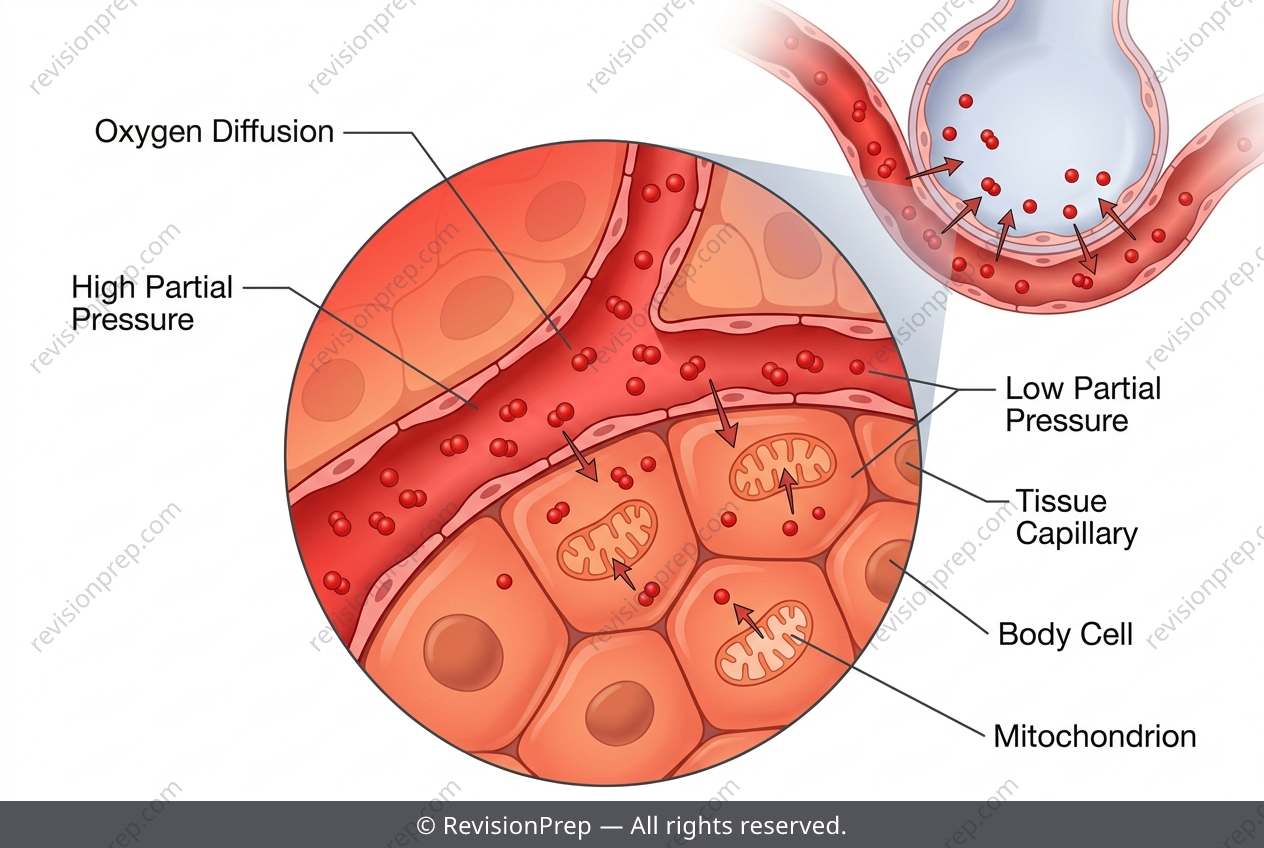
Biology: Why Oxygen Always Flows Toward Mitochondria
Gas exchange depends on partial pressure gradients, the differences in the concentration of a gas between two locations that drive its net movement. Oxygen travels from regions of higher pO₂ to regions of lower pO₂, and this principle governs how O₂ is loaded in the lungs and unloaded in respiring tissues. In the alveolus and pulmonary vein, pO₂ is relatively high, while the tissue capillary and mitochondrion sit much lower, creating a steep cascade that keeps oxygen flowing steadily toward the cells that consume it. This gradient matters because cellular respiration depends on a continuous oxygen supply, and mitochondria maintain the lowest pO₂ of all, acting as the final sink. Comparing the pO₂ at each site reveals the direction of net diffusion: oxygen moves from the capillary into surrounding cells whenever the capillary value exceeds the cellular value. Understanding this relationship between partial pressure, diffusion direction, and metabolic demand is central to explaining how form and function connect in gas exchange systems.
Start practising IB questions today
150,000+ IB-styled questions, criteria-mapped and instantly accessible.