
Maths: Discrete vs Continuous? Understanding Data Types
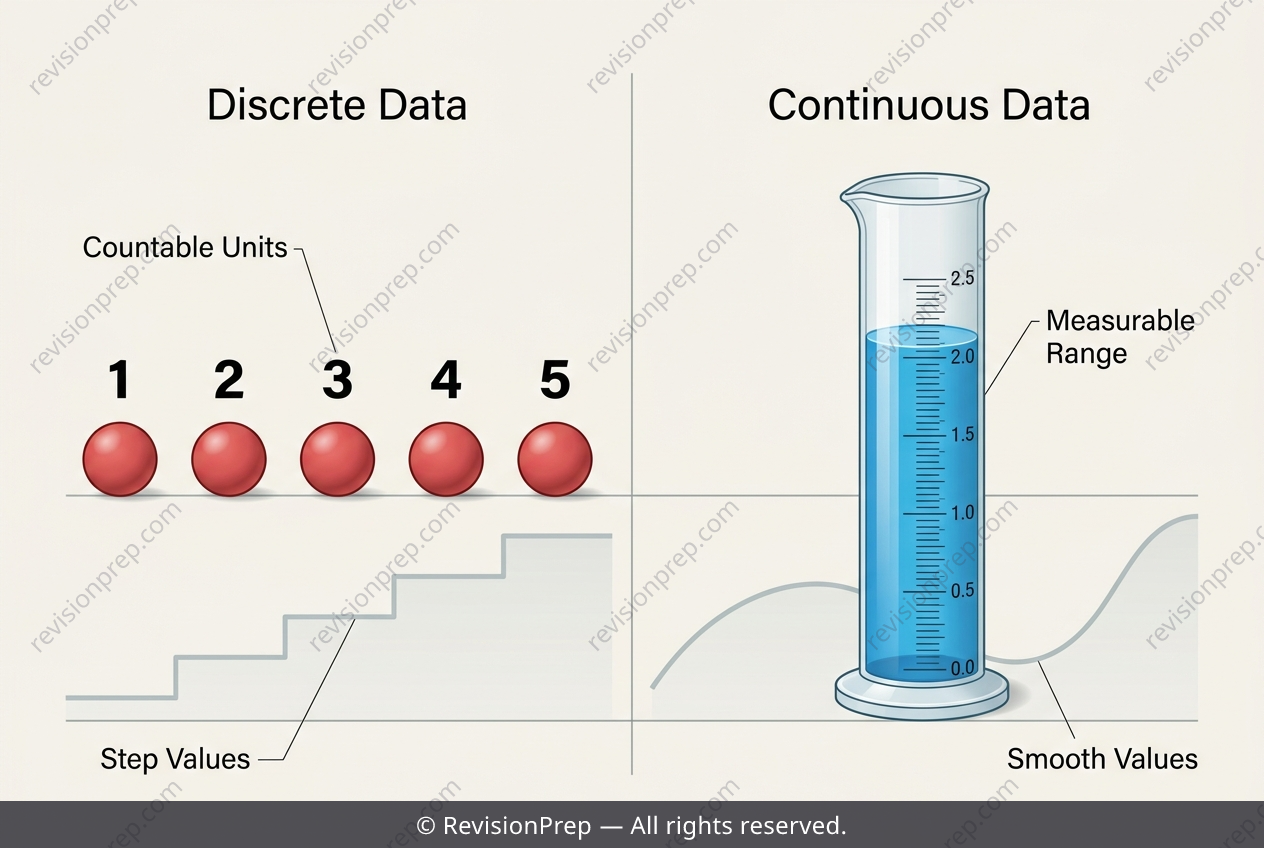
Data in mathematics falls into two broad families: discrete and continuous. Discrete data arises from counting, producing only separate, distinct whole-number values such as 1, 2, 3, and so on. Continuous data, by contrast, arises from measurement and can take any value within a range, however finely divided. Recognising which family a data set belongs to shapes how it can be handled, displayed, and interpreted. The distinction matters because it reflects what the numbers actually represent. Counted objects exist only as complete units — a book, pencil, or ruler is either present or absent, never split into parts. This is why values such as 2.5 pencils or 1.7 rulers are impossible: counting cannot produce fractions of a physical object. Discrete data therefore takes only separate, whole-number values, while continuous data flows smoothly between values. Understanding this boundary is the foundation for choosing appropriate statistical methods later.
Start practising IB questions today
150,000+ IB-styled questions, criteria-mapped and instantly accessible.