
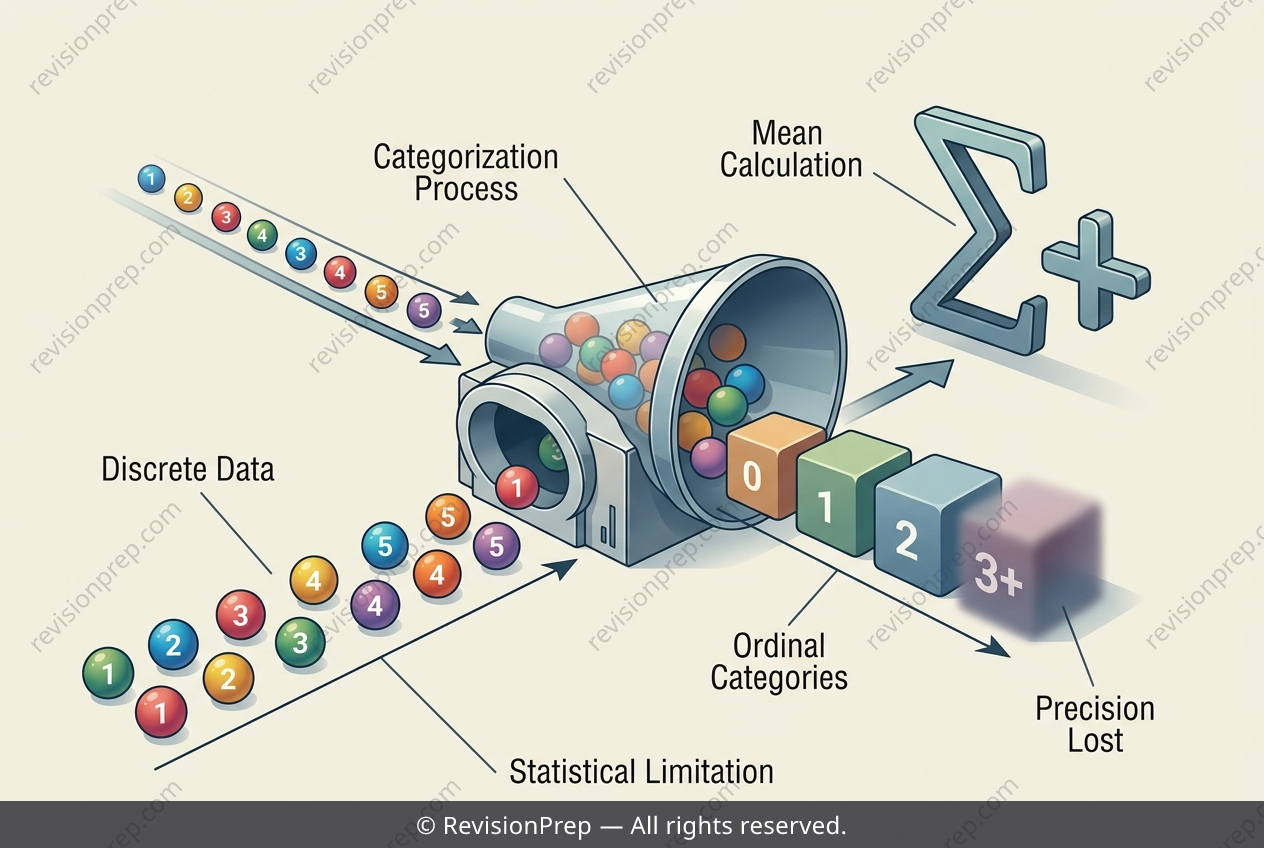
Maths: Why ‘3+’ Makes the Mean Impossible
Data types shape what statistics you can legitimately calculate. Numerical data arise from measurements or counts, while categorical data sort responses into groups. Discrete numerical data, such as a count of siblings, take only whole-number values (0, 1, 2, 3, …), whereas continuous data can take any value within a range. Categorical data may be nominal, with no natural order, or ordinal, where categories follow a fixed sequence but carry no exact numerical value. This distinction matters because it determines which summary statistics remain valid. A mean requires an exact value for every observation, so it works for numerical data but breaks down once responses are grouped. An open-ended category such as "3+" collapses several counts (3, 4, 5, …) into one ordered label, turning discrete numerical data into ordinal categorical data. No single number represents that group, so any mean built on an assumed value misrepresents the true average. Recognising these relationships is central to judging statistical validity.
Start practising IB questions today
150,000+ IB-styled questions, criteria-mapped and instantly accessible.