
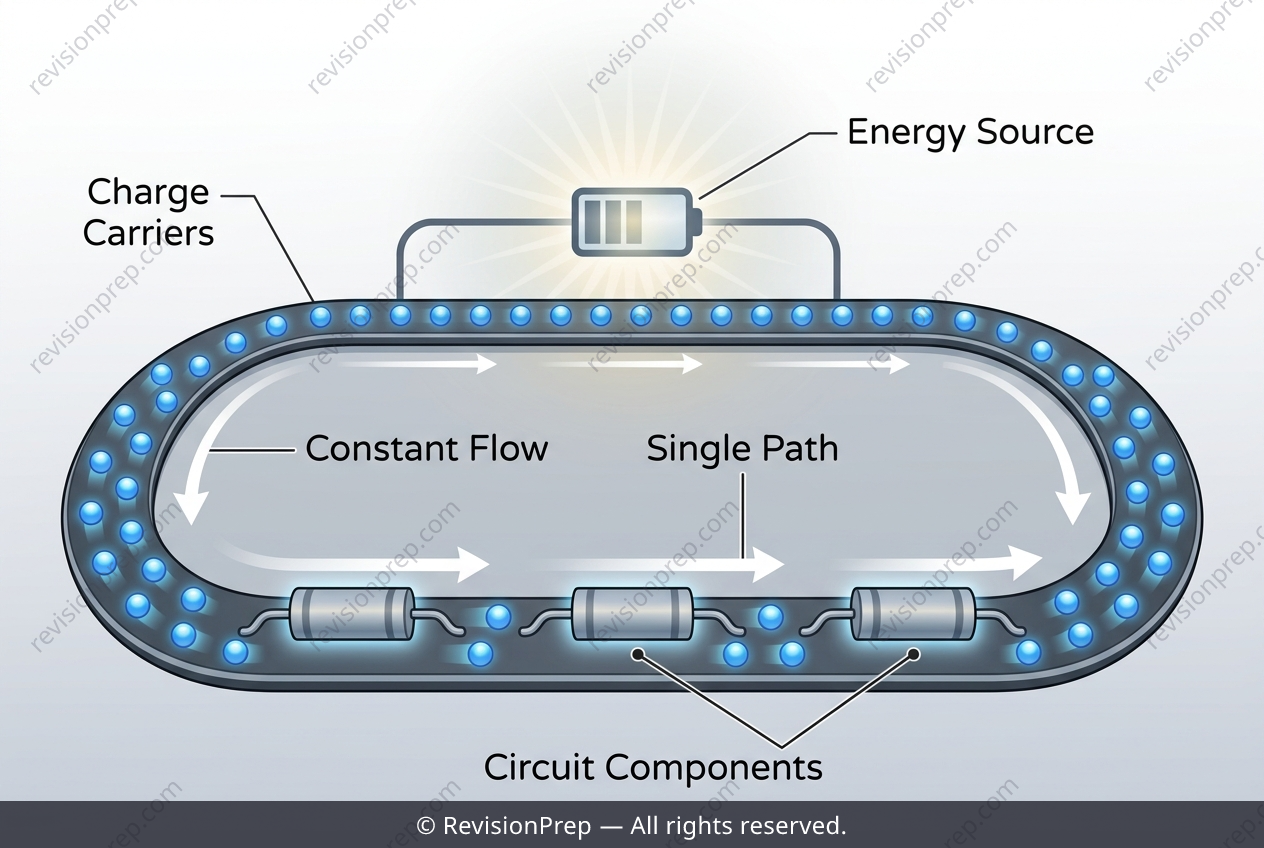
Physics: Conservation of Charge in a Series Loop
In a series circuit, components are connected end-to-end to form a single, unbroken loop, so the current has only one route to follow. This means charge cannot split, accumulate, or disappear as it travels around the circuit — the same current passes through every component in turn, regardless of where it is measured. This idea is a direct consequence of the conservation of charge: charge entering one part of the loop must equal charge leaving it, since none can escape a closed path. Understanding this matters because it underpins how current behaves in any series arrangement, from simple bulb circuits to more complex electrical systems. If the current is identical at every point, then a single ammeter reading describes the whole circuit, and the current is related to total resistance and battery voltage by I = V / R. Each bulb still transfers energy, but this reduces the energy per unit charge, not the current itself.
Start practising IB questions today
150,000+ IB-styled questions, criteria-mapped and instantly accessible.