
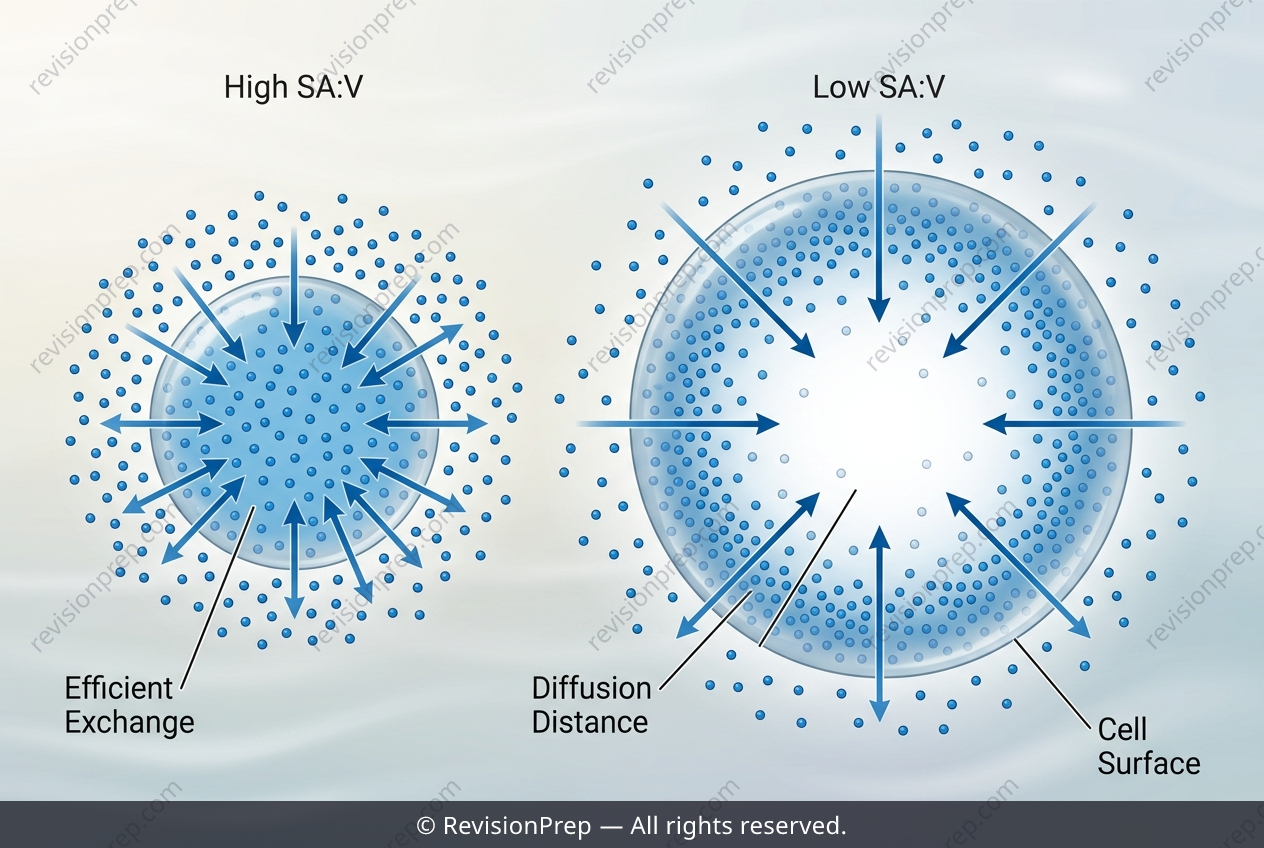
Biology: How Cell Size Limits Exchange Efficiency
Why can a single cell never grow indefinitely? The answer lies in the surface area-to-volume ratio, the geometric principle governing how efficiently organisms exchange substances with their surroundings. As a cell or organism enlarges, its volume increases faster than its surface area, so the ratio of surface area (SA = 6s²) to volume (V = s³) steadily falls. This matters because every exchange — oxygen in, carbon dioxide and waste out — must cross the outer surface. A high SA:V ratio exposes plenty of membrane relative to the internal volume that must be served, keeping diffusion distances short and exchange rapid. As size increases, that same surface must supply a proportionally larger volume, and the maximum distance from surface to centre grows. Diffusion, driven by concentration gradients, becomes too slow to meet metabolic demand. The relationship between size, ratio, and exchange efficiency therefore shapes why cells stay small, why organisms evolve specialised exchange surfaces, and why diffusion alone limits biological size.
Start practising IB questions today
150,000+ IB-styled questions, criteria-mapped and instantly accessible.