
Biology: How Diffusion Transmits Signals at Synapses
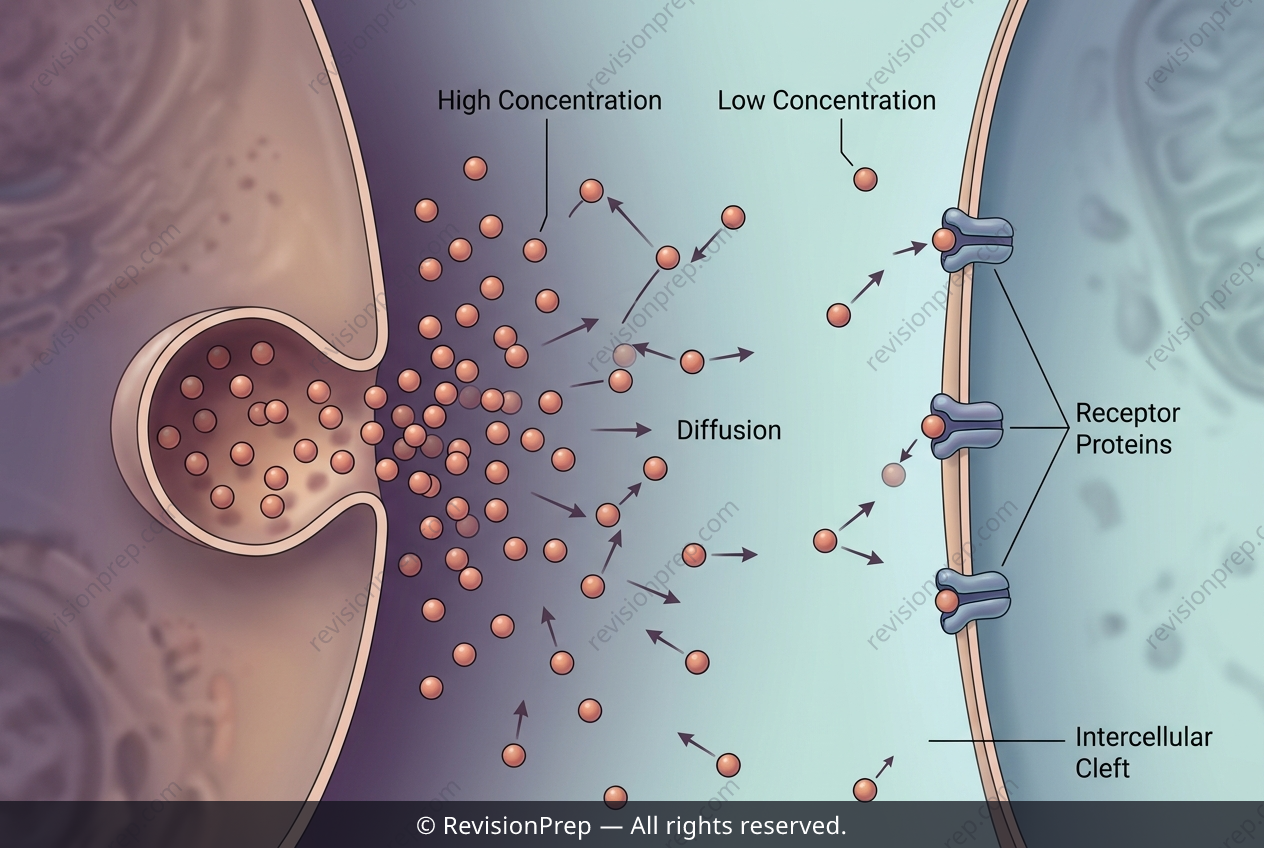
Diffusion is the passive movement of particles from a region of higher concentration to a region of lower concentration, driven entirely by the random motion of molecules. It underpins countless biological processes, from gas exchange in alveoli to the transmission of nerve impulses, and it becomes especially important when distances are tiny and speed is essential. Nowhere is this clearer than at the neuromuscular junction. Acetylcholine is released from synaptic vesicles into the synaptic cleft, creating a high concentration on the presynaptic side. Because receptors on the postsynaptic membrane bind and rapidly remove the neurotransmitter, its concentration there stays near zero, producing a steep concentration gradient. This gradient drives net diffusion across the cleft. Since the cleft is only 20–40 nm wide, diffusion is fast enough to transmit the signal in under a millisecond, making active transport unnecessary and energetically wasteful.
Start practising IB questions today
150,000+ IB-styled questions, criteria-mapped and instantly accessible.