
Biology: How Cell Structure Supports Function
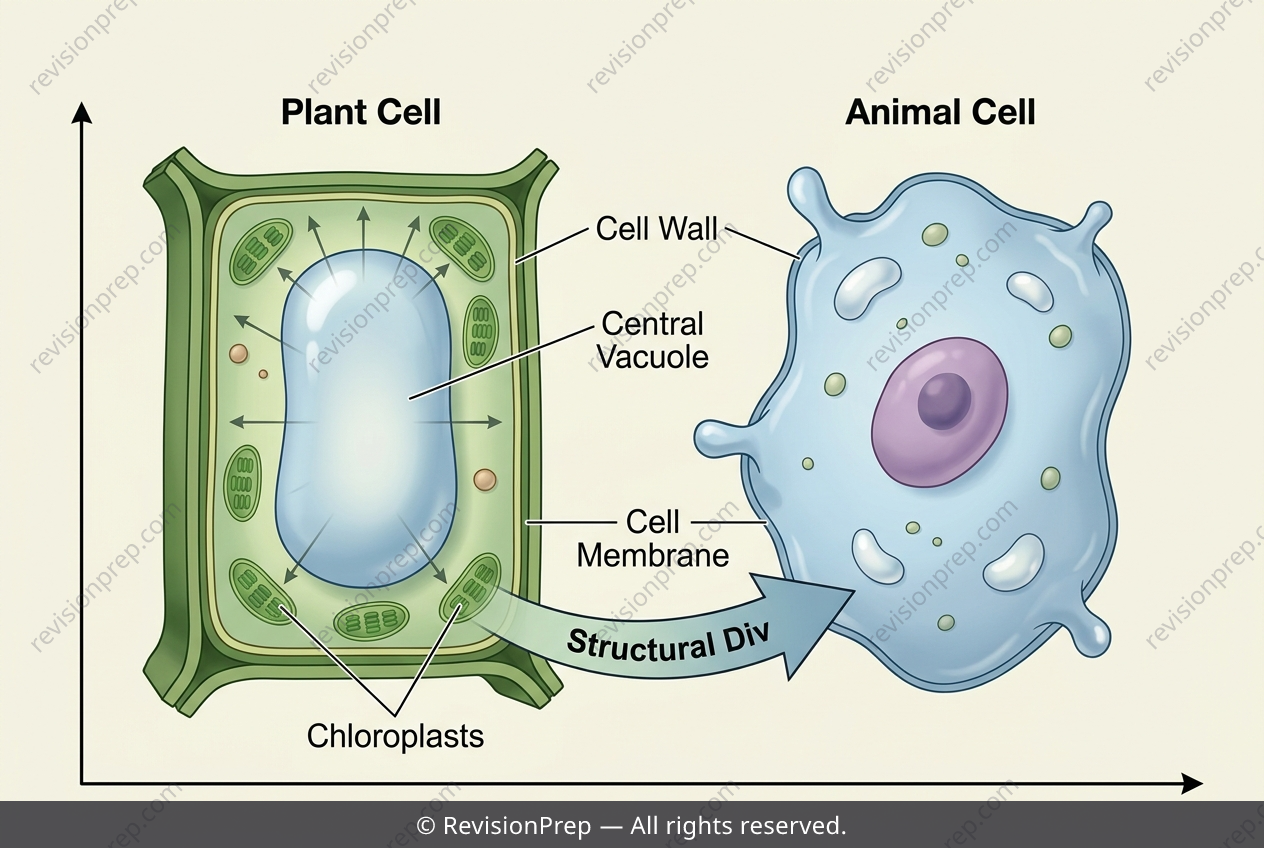
Every cell’s form is shaped by its function, and nowhere is this clearer than when comparing a plant’s leaf mesophyll cell with a human cheek cell under a light microscope. The mesophyll cell appears green and box-like, while the cheek cell looks irregular and flattened. These visible differences reflect deeper structural distinctions: the plant cell possesses a cellulose cell wall, chloroplasts, and a large central vacuole, none of which appear in the cheek cell. The cell wall provides a fixed, rigid boundary, while chloroplasts enable photosynthesis, and the vacuole stores water, generating turgor pressure that pushes the cytoplasm outward against the wall, giving the cell its structural rigidity. Yet rigidity is not universally advantageous. A white blood cell depends on changing shape to squeeze through capillary walls and engulf pathogens by phagocytosis, so a fixed wall would prevent these essential immune functions. Structure and function are therefore inseparable: each cellular component exists because it supports a specific role within the organism.
Start practising IB questions today
150,000+ IB-styled questions, criteria-mapped and instantly accessible.