
Biology: How Surface Area to Volume Ratio Limits Cell Growth
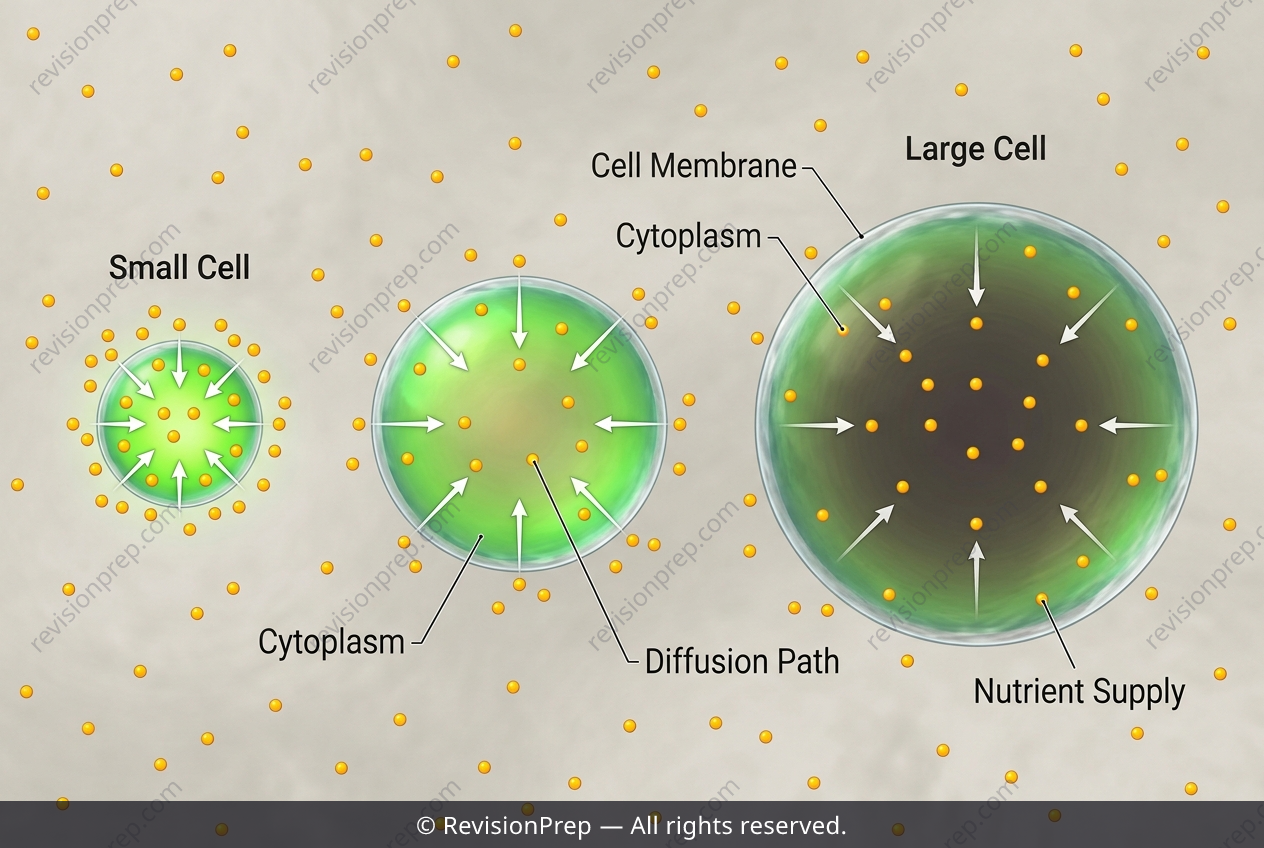
Why can't cells simply grow larger? The answer lies in the surface area to volume ratio, or SA:V — a geometric relationship that shapes how efficiently a cell exchanges materials with its surroundings. Surface area scales with the square of a cell's linear dimension (6 × side² for a cube), while volume scales with the cube (side³). As a cell enlarges, its volume therefore outpaces its surface area, and the SA:V ratio steadily falls. This matters because diffusion alone must supply nutrients and remove wastes across the membrane. A high SA:V ratio means more membrane is available per unit of cytoplasm, keeping diffusion gradients effective and allowing substances to reach the cell's interior rapidly. A low ratio means a longer diffusion distance and insufficient surface area to serve the larger volume, so diffusion becomes less efficient. Comparing a small and a large cube-shaped cell shows how dramatically this ratio changes with size — and why it ultimately limits how big a cell can become.
Start practising IB questions today
150,000+ IB-styled questions, criteria-mapped and instantly accessible.