
Biology: How Temperature Speeds Up Diffusion
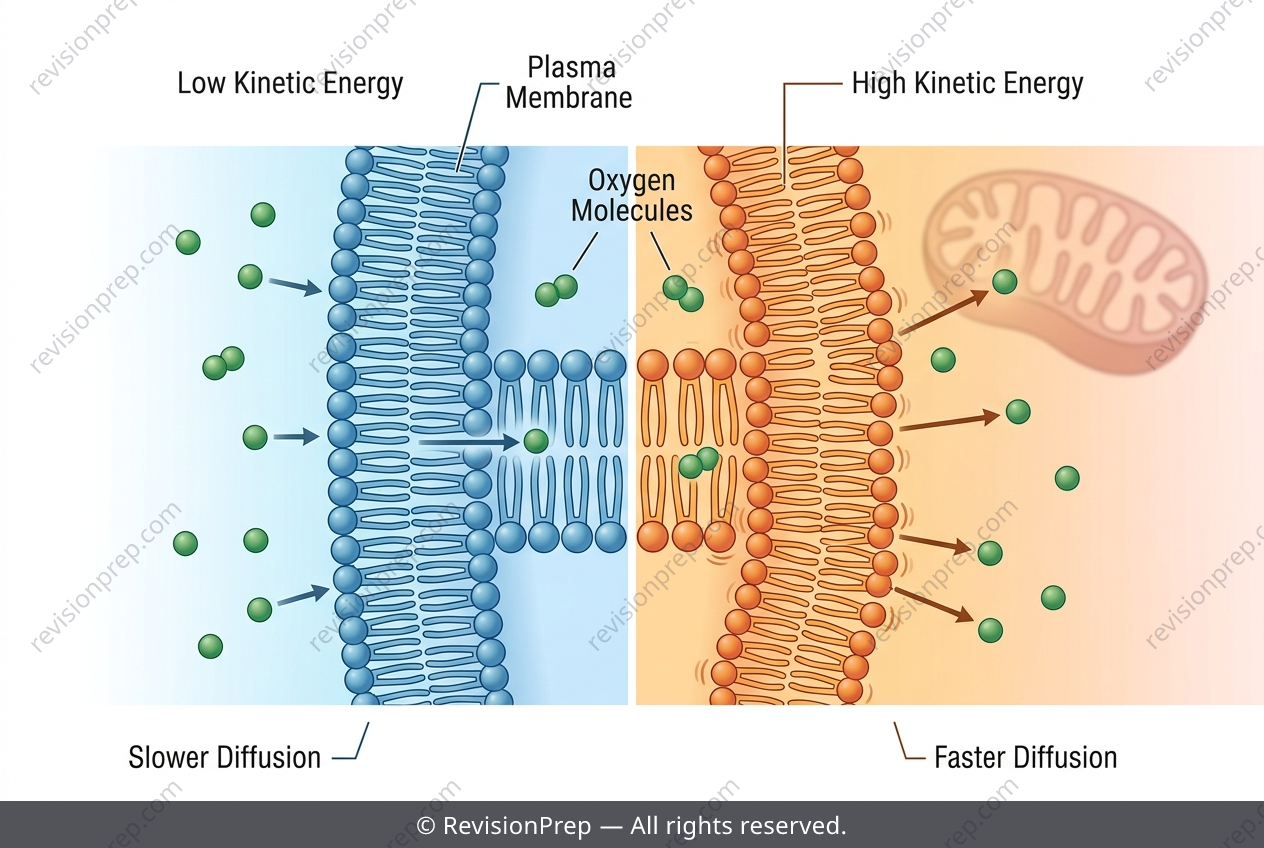
Diffusion is the passive movement of particles from a region of higher concentration to a region of lower concentration, driven entirely by their intrinsic kinetic energy. Oxygen molecules, for instance, drift randomly until they collide with a plasma membrane and slip across it, gradually flattening the concentration gradient that separates the extracellular environment from the cell interior. The steeper that gradient, the more frequently such crossings occur, and the faster it dissipates. Temperature sits at the heart of this relationship. Raising it from 20 °C to 37 °C increases the kinetic energy of oxygen molecules, so they move faster and strike the membrane more often, while membrane permeability itself rises. More molecules therefore cross per unit time, accelerating gradient dissipation. This matters physiologically: oxygen must reach the mitochondrial matrix to act as the final electron acceptor in the electron transport chain. Slow that supply, and aerobic respiration, ATP production, active transport, muscle contraction, and biosynthesis all suffer.
Start practising IB questions today
150,000+ IB-styled questions, criteria-mapped and instantly accessible.