
Biology: How Temperature Affects Enzyme Function
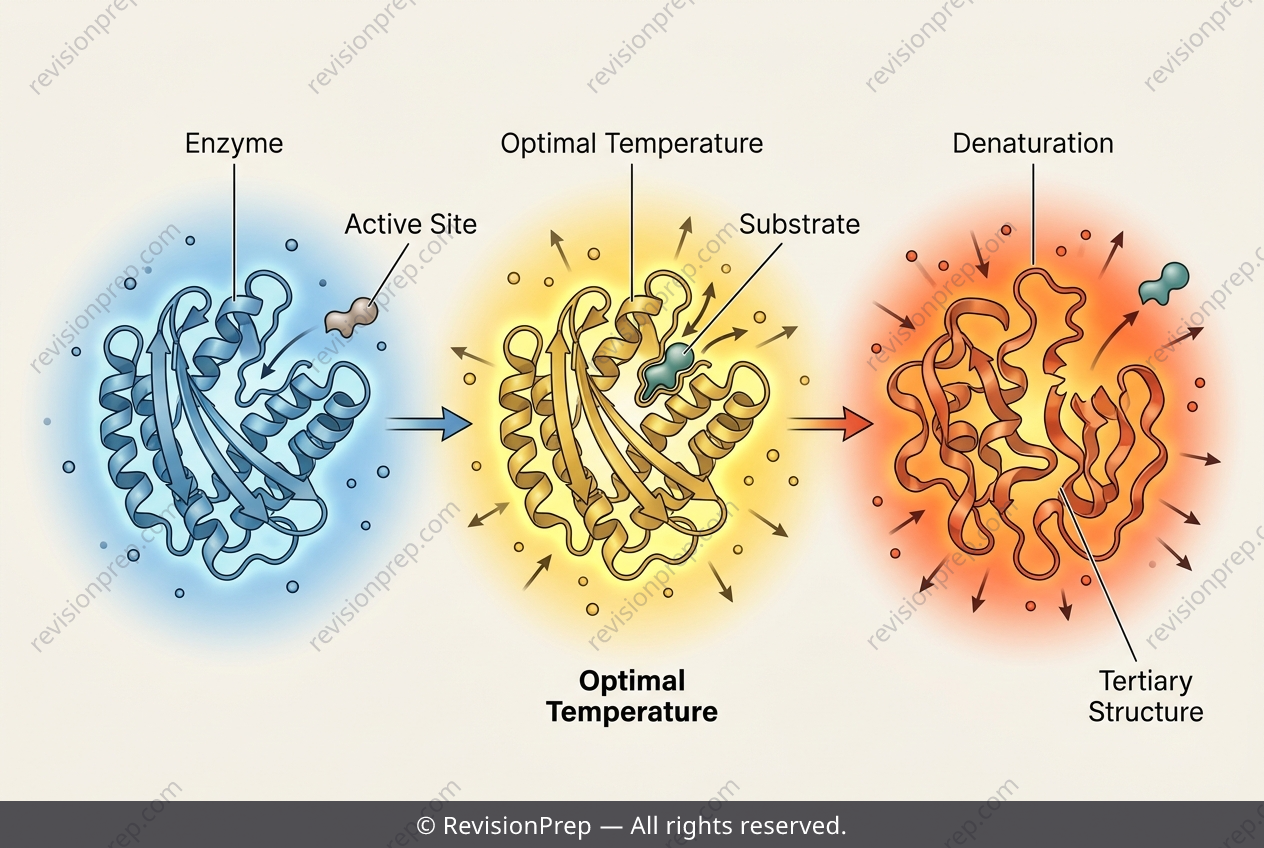
Enzymes are biological catalysts whose function depends entirely on shape. Each enzyme possesses a precisely folded tertiary structure, held together by hydrogen bonds and other weak intermolecular forces, which creates an active site complementary to its specific substrate. This structure–function relationship governs every reaction in metabolism, because catalysis occurs only when substrate molecules bind to form enzyme–substrate complexes at that active site. Temperature powerfully influences this relationship. Rising thermal energy increases molecular motion, so enzyme and substrate collide more frequently, raising the reaction rate. Yet the same energy that speeds collisions also stresses the weak bonds maintaining the enzyme's folded shape. Beyond an optimum temperature, these bonds begin to break, the active site loses its complementary form, and productive collisions decline. Excessive heat causes irreversible denaturation, permanently destroying catalytic activity. Understanding this balance between kinetic energy and molecular stability explains why human digestive enzymes, adapted to body temperature, function within a narrow thermal range and cease working entirely when heated too far.
Start practising IB questions today
150,000+ IB-styled questions, criteria-mapped and instantly accessible.