
Chemistry: How Atomic Composition Classifies Substances
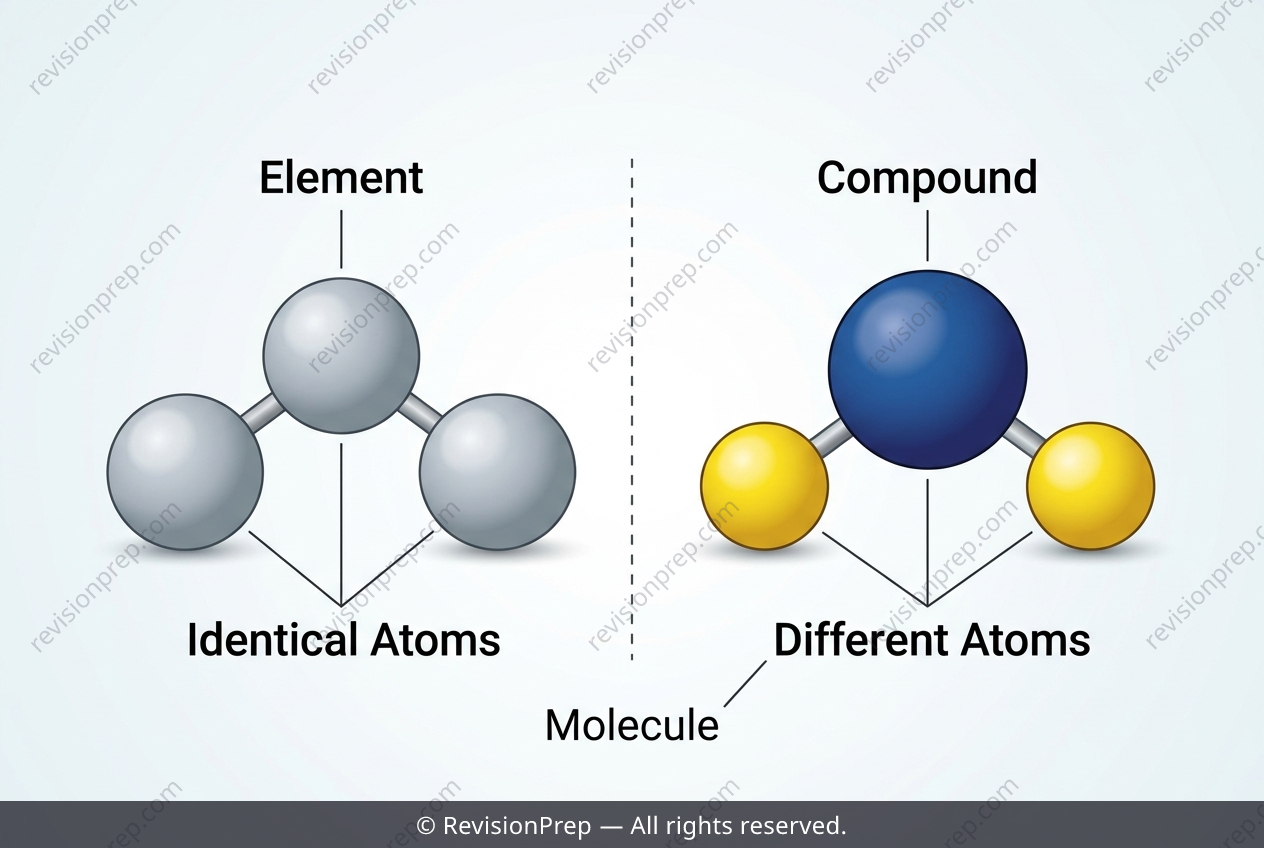
At its heart, classifying matter comes down to one question: what kinds of atoms are present, and how are they arranged? A pure substance can be either an element or a compound, and the distinction rests entirely on atomic composition rather than on how many atoms sit inside each particle. An element contains only one type of atom, even when those atoms pair up into molecules such as O₂. A compound, by contrast, contains two or more different types of atoms chemically bonded together, as in H₂O, where hydrogen and oxygen are joined within each molecule. This idea matters because the whole language of chemistry — formulas, reactions, and the periodic table — depends on recognising what a substance is actually made of. The key relationship to hold onto is that chemical bonding, not simple atom counting, defines a compound. Diatomic oxygen and water both consist of molecules, yet only water combines different elements. Reading particle models this way lets you move confidently from a picture of atoms to a proper chemical classification.
Start practising IB questions today
150,000+ IB-styled questions, criteria-mapped and instantly accessible.