
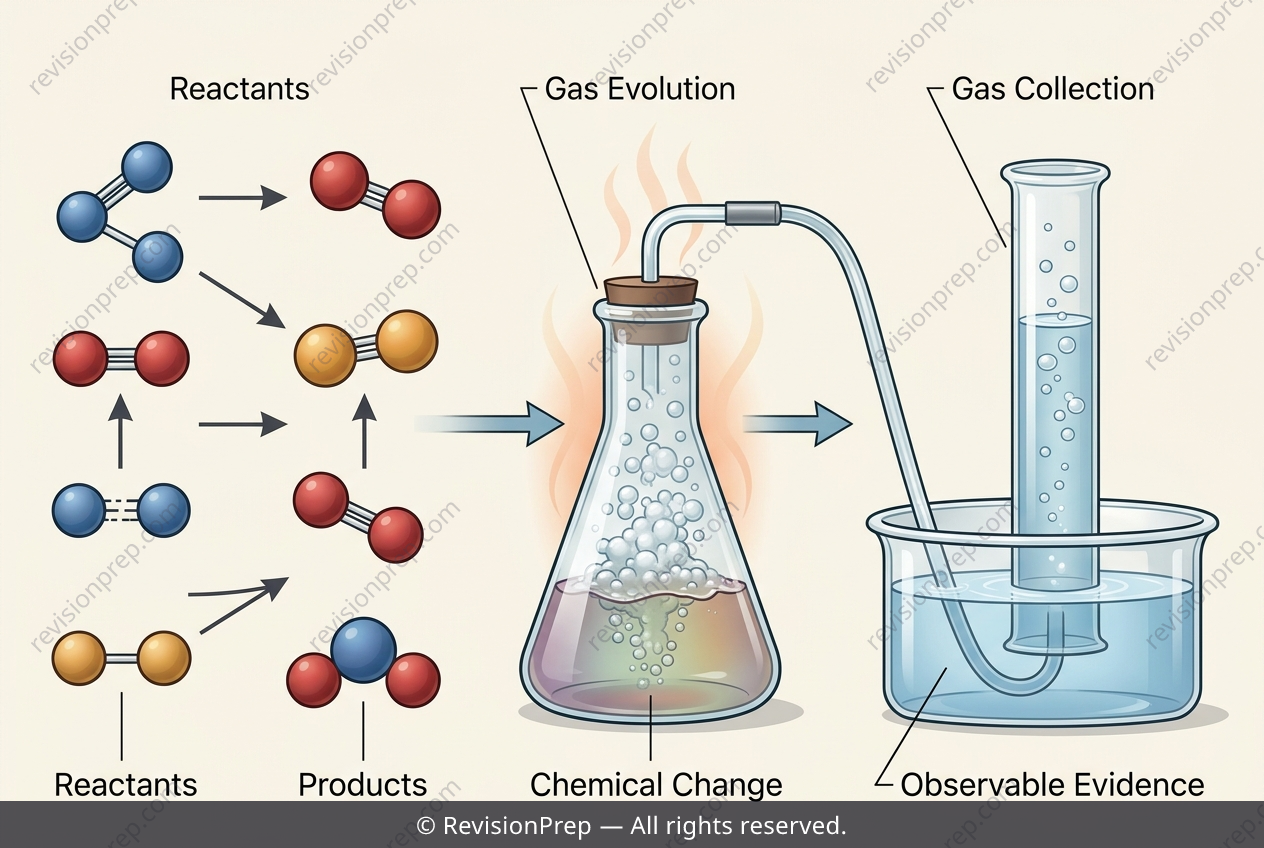
Chemistry: How Effervescence Reveals Chemical Change
Chemical changes are not just a theoretical idea — they are visible events you can observe, describe, and even capture. When magnesium ribbon meets dilute hydrochloric acid, the reaction produces hydrogen gas, and the setup used to collect it introduces two essential ideas: recognising evidence of chemical change and understanding how gases are channelled and gathered in the laboratory. Effervescence — the steady stream of bubbles rising from the metal — is one of the clearest observable signs that a new substance is forming. Those bubbles are hydrogen, generated as the magnesium displaces hydrogen from the acid: Mg + 2HCl → MgCl2 + H2. The apparatus itself matters too. A delivery tube carries that gas away from the reaction vessel and into the collection system, linking the chemistry happening in the test tube to the gas you eventually measure or test. Together, the observation and the equipment show how a reaction's invisible products become something you can see, direct, and study.
Start practising IB questions today
150,000+ IB-styled questions, criteria-mapped and instantly accessible.