
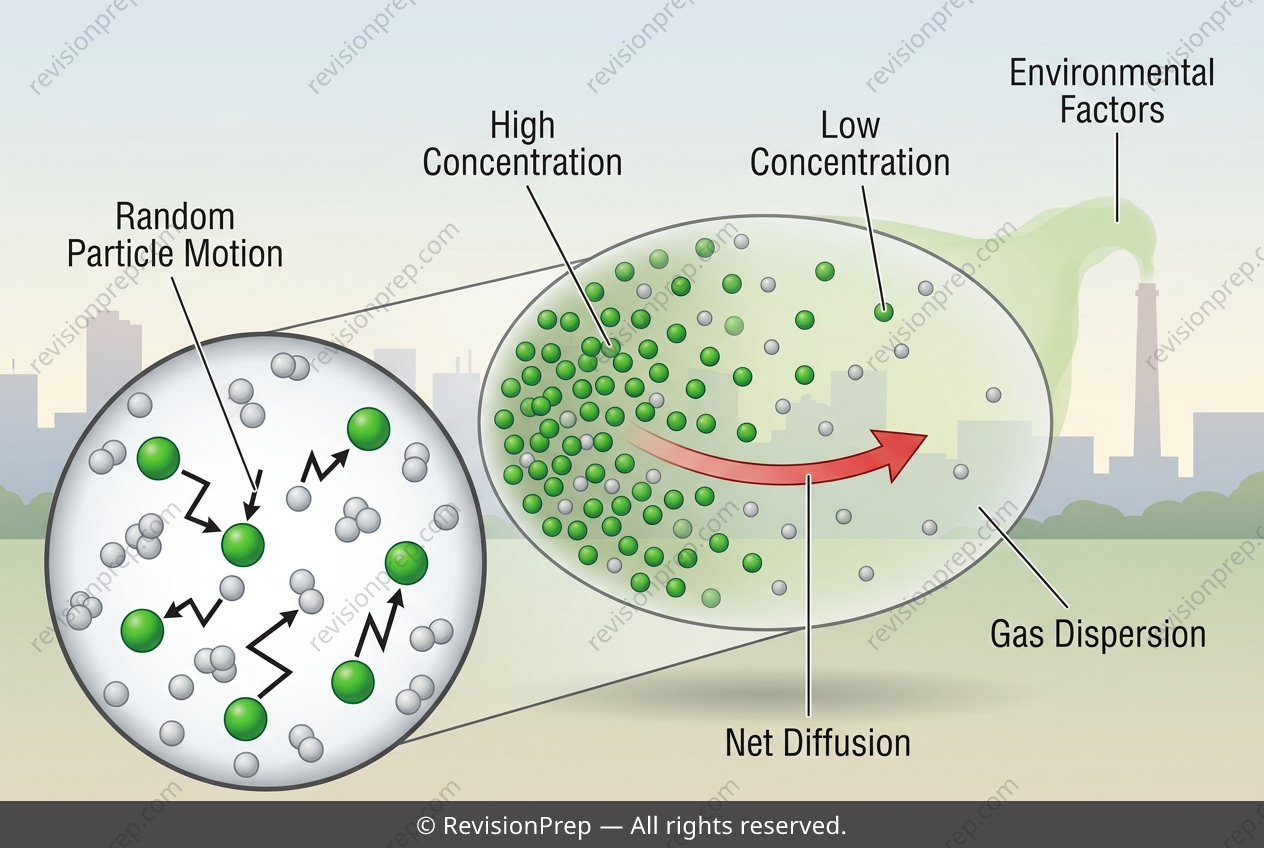
Chemistry: How Brownian Motion Explains Gas Diffusion
Brownian motion describes the ceaseless, random movement of microscopic particles suspended in a fluid, caused by unequal collisions with the surrounding molecules. In a visible gas plume, coloured particles are bombarded from all directions by rapidly moving air molecules. Because these collisions are unequal and unpredictable, each particle follows a zigzag path, so the gas gradually spreads outward — even on a completely still day. This matters because Brownian motion underpins diffusion and helps explain how gases mix without any external force. Yet it captures only the microscopic picture. Real pollution transport across a city is dominated by larger-scale factors such as wind currents and pressure differences, which random collisions alone cannot predict. Understanding both scales — the particle-level collisions and the meteorological forces acting on them — is essential for connecting molecular kinetic theory to observable environmental behaviour.
Start practising IB questions today
150,000+ IB-styled questions, criteria-mapped and instantly accessible.