
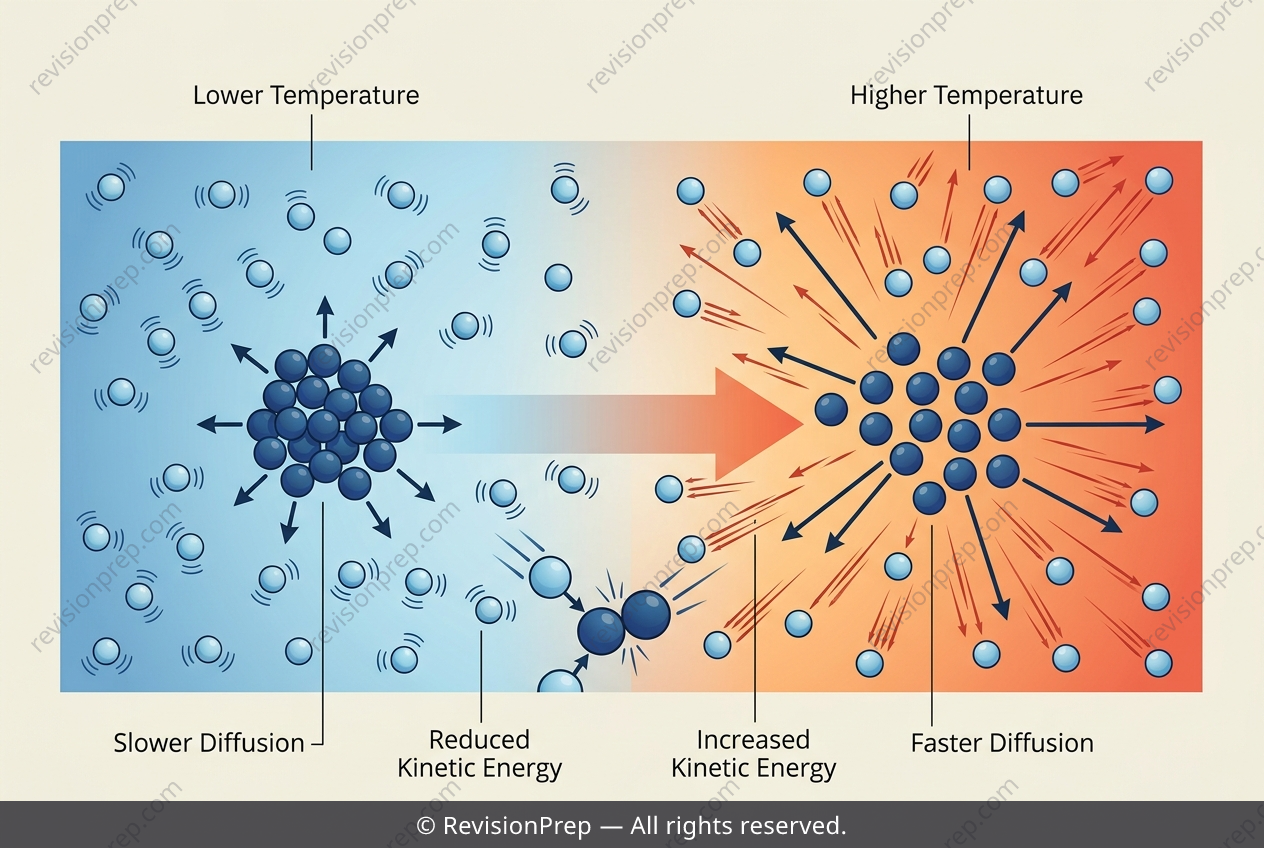
Chemistry: How Kinetic Energy Affects Diffusion Rate
Diffusion is the spontaneous movement of particles from a region of higher concentration to one of lower concentration, driven entirely by their random thermal motion. In liquids, this process is visible when a drop of dye spreads through water without any stirring, and its speed depends strongly on temperature. The kinetic theory of matter explains why: all particles possess kinetic energy, and their average kinetic energy is proportional to absolute temperature measured in kelvin, not degrees Celsius. Temperature therefore governs how quickly particles move, how often they collide, and how rapidly diffusion proceeds. Raising the temperature increases average kinetic energy, so particles travel faster and disperse more quickly. Because particle speed depends on the square root of kinetic energy, the relationship between temperature and diffusion rate is not linear — a subtle but important point when comparing beakers held at different temperatures.
Start practising IB questions today
150,000+ IB-styled questions, criteria-mapped and instantly accessible.