
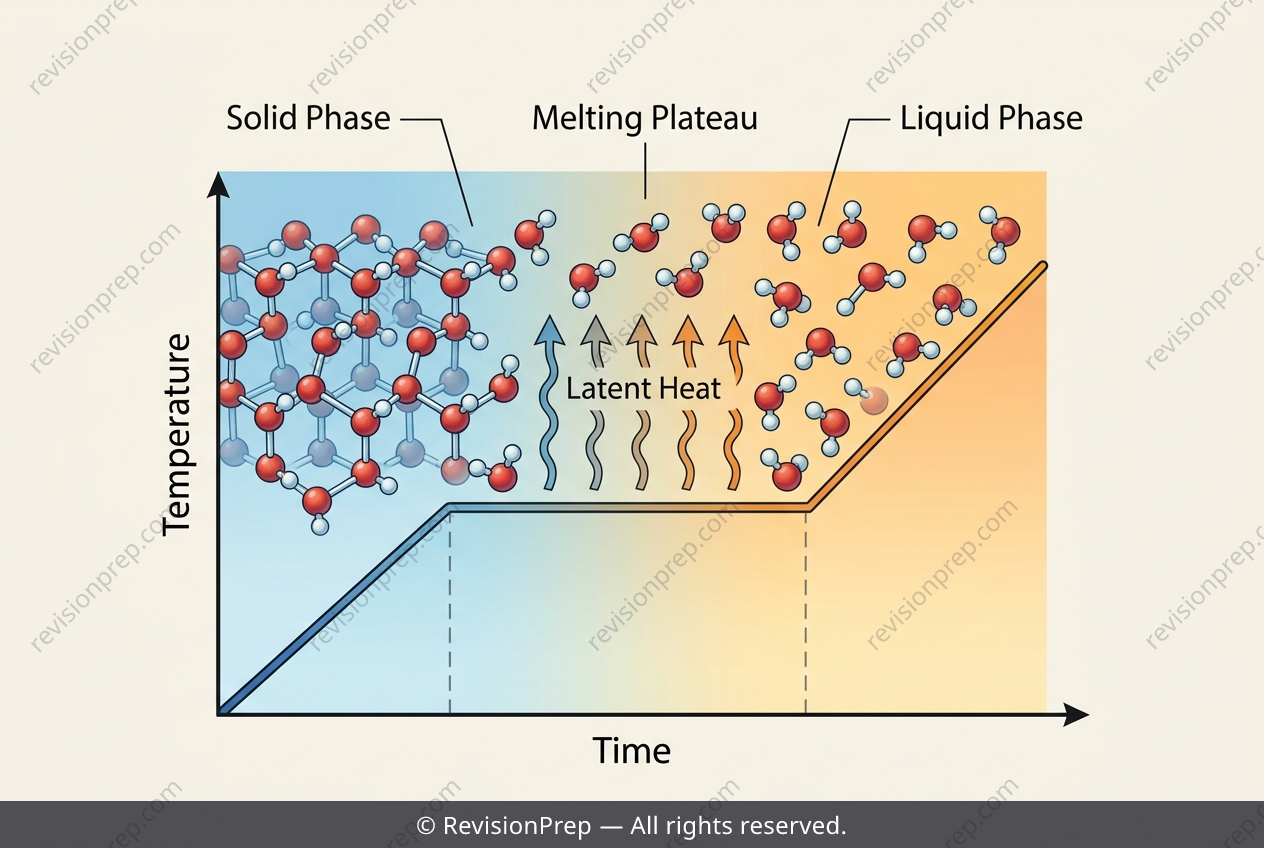
Chemistry: How Latent Heat Creates the Melting Plateau
Investigating a change of state means tracking two things at once: how the temperature behaves and how time passes. In this experiment, crushed ice is warmed steadily while its temperature is recorded at fixed intervals until every last crystal has melted. A thermometer — digital, alcohol or mercury — captures the temperature at each moment, while a stopwatch or timer marks the 30-second spacing between readings. Together they turn a simple beaker of ice into a data set. The concept beneath this is latent heat. While ice melts, energy is absorbed without any rise in temperature, so the graph flattens into a plateau even though heat keeps flowing in. That energy is described by Q = mL, where L is the specific latent heat of fusion. Once melting finishes, the same energy input raises the temperature of the water instead. Recognising where the plateau ends and the slope begins is what connects the apparatus to the physics.
Start practising IB questions today
150,000+ IB-styled questions, criteria-mapped and instantly accessible.