
Chemistry: Melting Point as a Test of Substance Purity
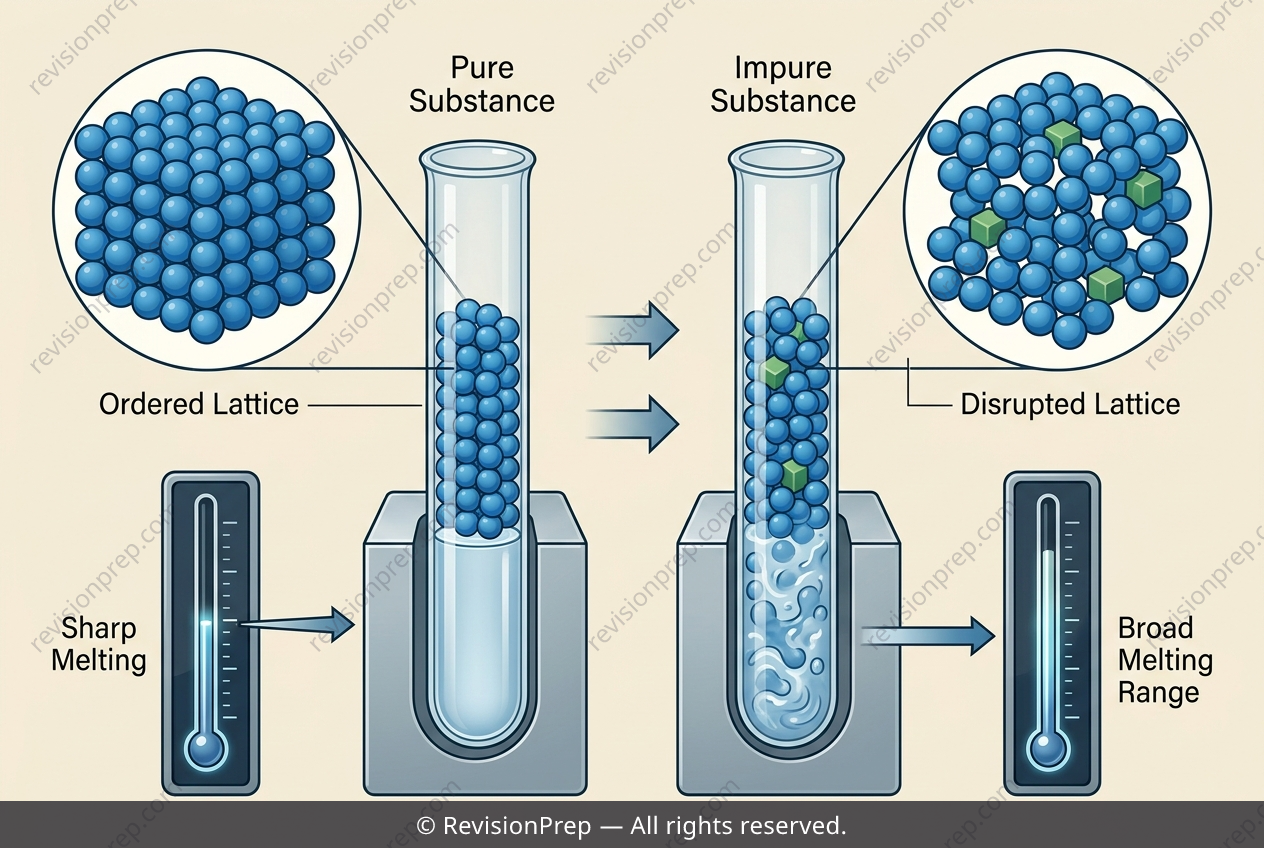
Melting point is one of the simplest yet most revealing physical properties a substance can offer. In a pure solid, particles pack into a regular, repeating crystal lattice held together by uniform intermolecular forces, so the solid melts sharply at a single characteristic temperature — paracetamol, for instance, melts between 169 °C and 171 °C. Impurities disrupt that lattice: they weaken the forces between particles, so the solid breaks down at a lower temperature and over a broader range. This matters far beyond the laboratory. For a pharmaceutical company, melting point data act as a rapid purity check: a sample melting within the accepted range is pure, while a depressed or widened range signals contamination. The consequences are real — an unidentified impurity could be toxic, or it could dilute the active ingredient so the patient receives an ineffective dose. Understanding how lattice integrity, intermolecular forces and melting behaviour connect is therefore essential, linking structure at the particle level to measurable, meaningful data.
Start practising IB questions today
150,000+ IB-styled questions, criteria-mapped and instantly accessible.