
Chemistry: Why Road Salt Affects Freezing and Ecosystems
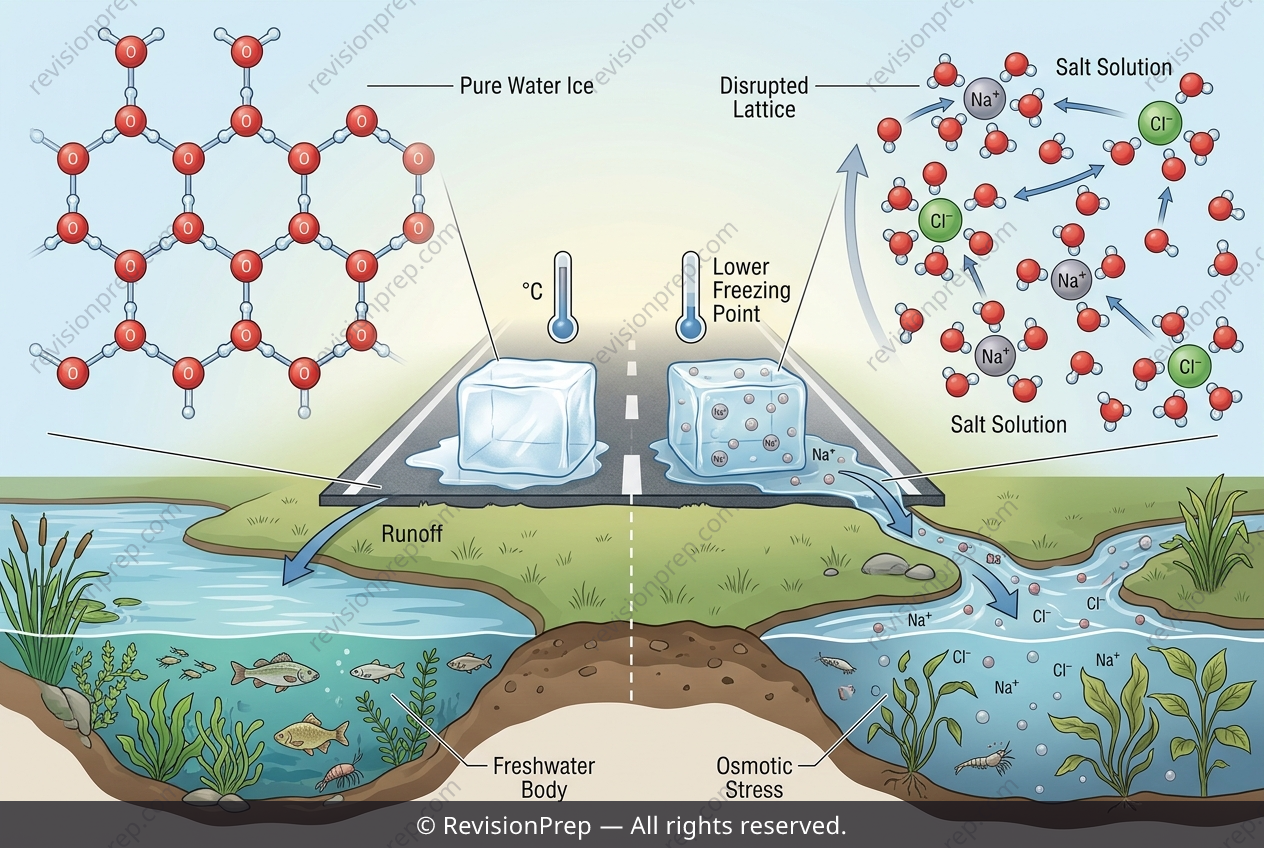
Why does scattering salt on an icy road actually work? The answer lies in freezing point depression, a colligative property describing how dissolving a solute in water lowers the temperature at which the liquid solidifies. When sodium chloride dissolves, it dissociates into Na+ and Cl− ions, which interfere with the orderly formation of the ice lattice. The result is a homogeneous mixture that stays liquid below 0 °C, melting existing ice and preventing new ice from forming. This concept matters far beyond winter roads, because the same dissolved ions that keep streets clear do not simply disappear. Runoff carries them into freshwater bodies, raising salinity and disturbing the osmotic balance that aquatic organisms depend on. Freshwater species are adapted to low-solute environments, so elevated ion concentrations draw water out of their cells by osmosis, causing dehydration, physiological stress, or death. Understanding freezing point depression therefore connects a simple physical property to a wider environmental consequence: the behaviour of solutions shapes both everyday problems and the ecosystems downstream of them.
Start practising IB questions today
150,000+ IB-styled questions, criteria-mapped and instantly accessible.