
Physics: Newton’s Third Law and Action–Reaction Pairs
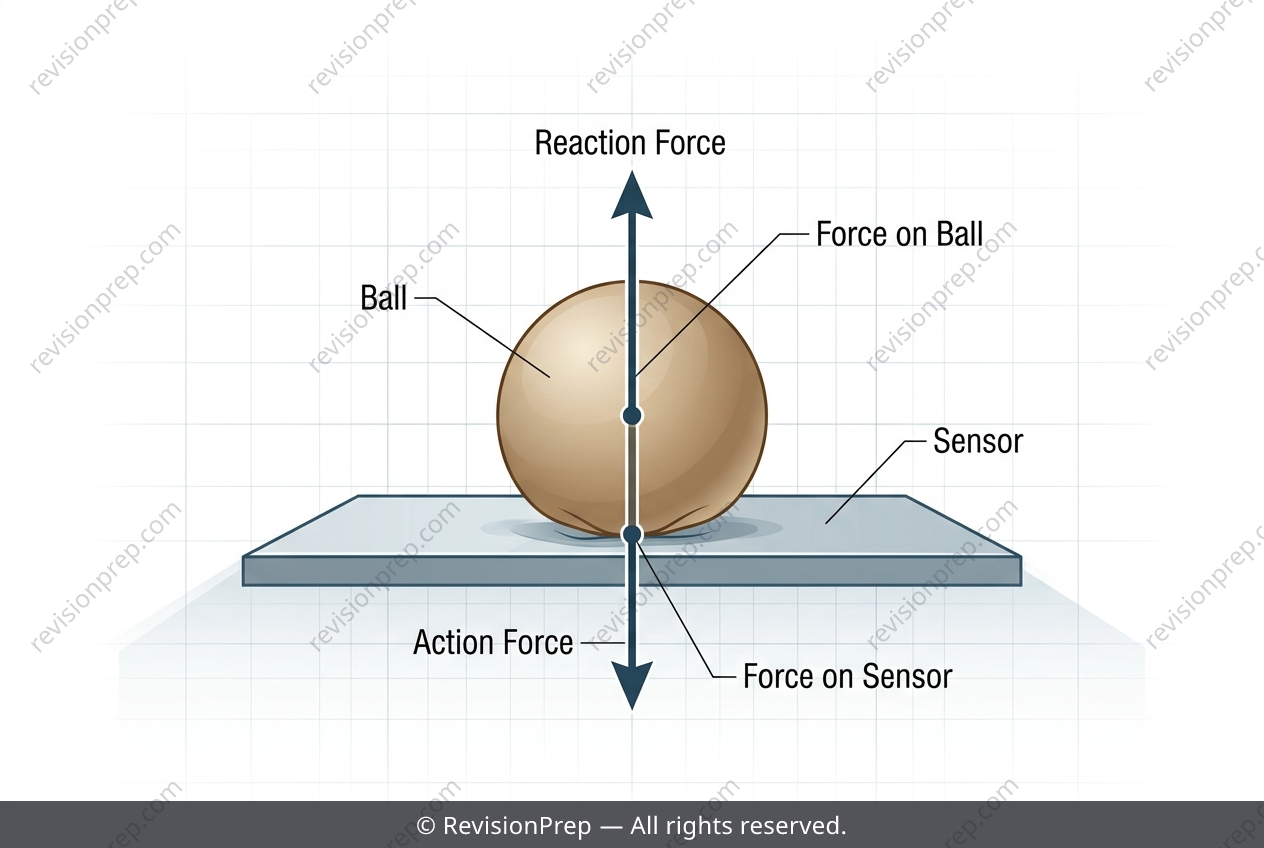
Newton's Third Law states that when object A exerts a force on object B, object B exerts a force on object A that is equal in magnitude and opposite in direction. These paired forces, known as action–reaction pairs, never act on the same object — one acts on each body involved in the interaction. This distinction matters because it explains why forces that are equal and opposite do not simply cancel out. In a collision, such as a ball dropped onto a force sensor, the ball pushes down on the sensor while the sensor pushes up on the ball with an identical force at every instant, not merely at the peak. The force–time graph captures this shared profile: whatever force the ball exerts, the sensor exerts the same magnitude back. Recognising that each force acts on a different object is the key to correctly analysing motion, since each body responds only to the forces acting on it.
Start practising IB questions today
150,000+ IB-styled questions, criteria-mapped and instantly accessible.