
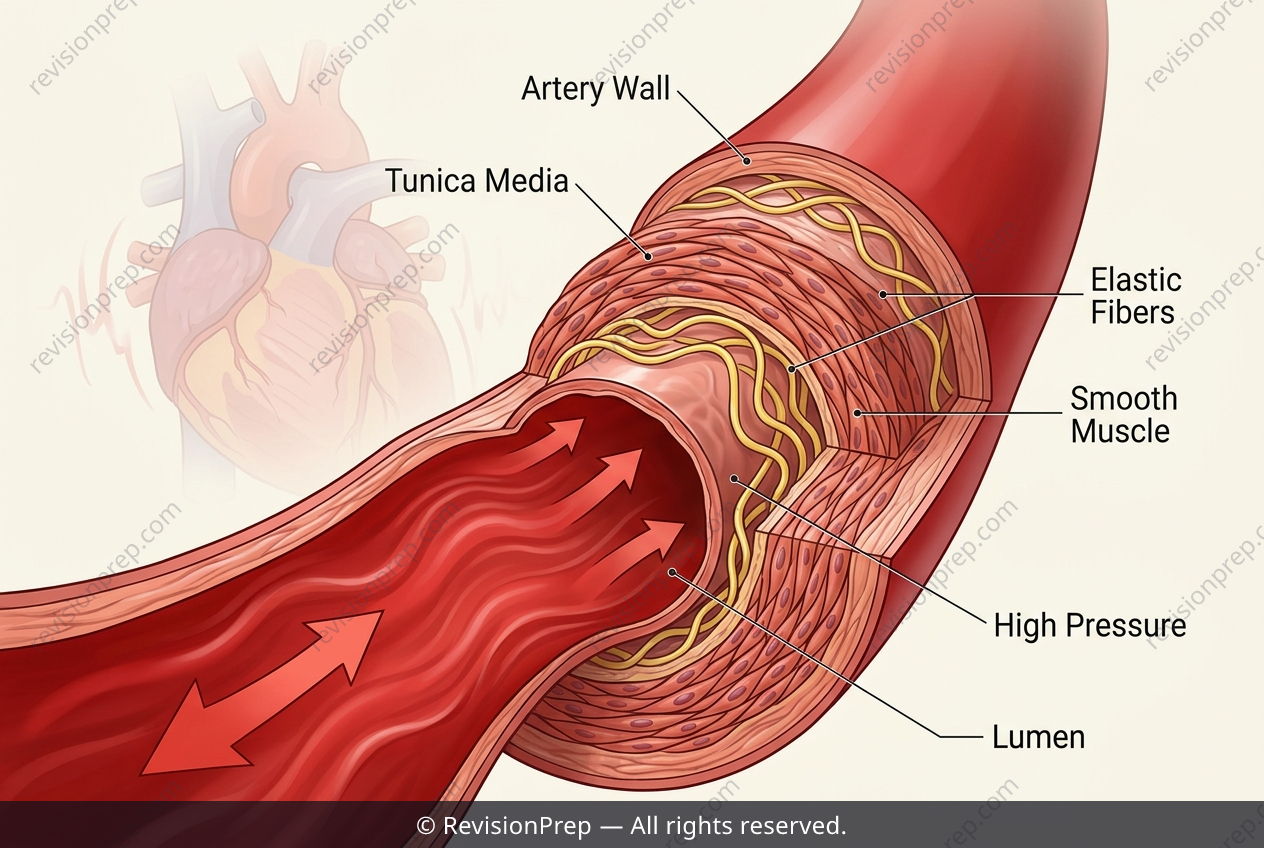
Biology: Why Vessel Wall Thickness Reflects Pressure
Every blood vessel in the body is built around a simple principle: structure follows function. Nowhere is this clearer than in the walls of arteries and veins, which share the same basic three-layer plan yet differ dramatically in thickness and composition. Arteries carry blood directly away from the heart, receiving it in forceful surges during each contraction, so their walls are packed with smooth muscle and elastic fibres that let them stretch under pressure and recoil afterwards. That recoil is not a passive property — it smooths the pulsing output of the heart into a more continuous flow, even while the heart relaxes between beats. Veins, by contrast, receive blood at much lower pressure and need thinner, more compliant walls, relying instead on valves to keep blood moving toward the heart. Comparing the two side by side reveals how each tissue layer — endothelium, muscle, elastic fibre — contributes to a specific job, and why wall thickness is a direct readout of the pressures a vessel must endure.
Start practising IB questions today
150,000+ IB-styled questions, criteria-mapped and instantly accessible.