
Biology: Why Subthreshold Signals Fade Before They Fire
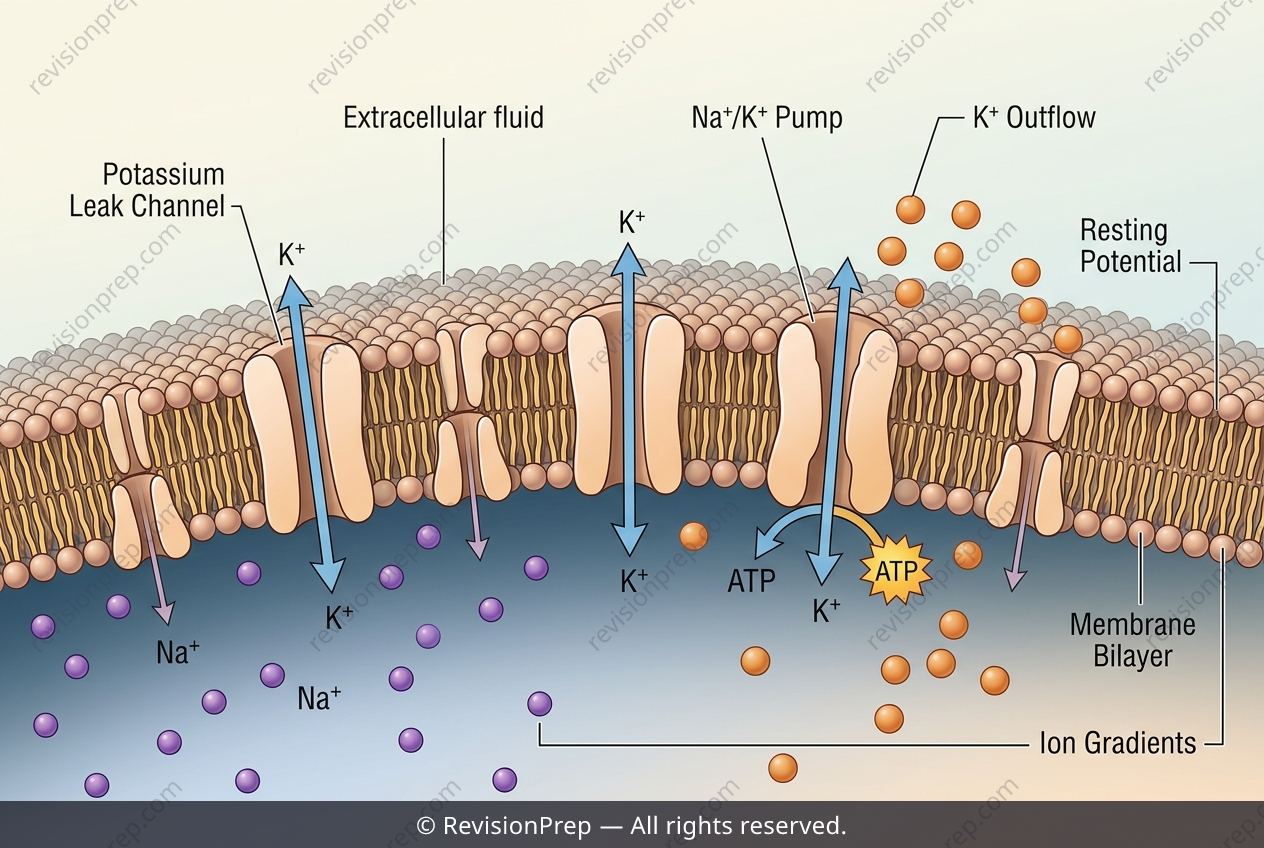
Every neuron maintains a resting membrane potential, typically around -70 mV, set by uneven ion distribution and selective membrane permeability. Potassium sits at high concentration inside the cell, sodium outside, and potassium leak channels keep the membrane far more permeable to K+ than to Na+. Because K+ diffuses outward down its gradient, the interior stays negative relative to the exterior. This electrochemical balance underlies the cell's readiness to signal. Not every stimulus triggers an action potential. Small inputs produce graded, subthreshold depolarizations that spread passively and fade with distance, decaying rather than regenerating. The critical distinction lies in what restores the membrane: potassium leak channels rapidly drive K+ outflow, returning the potential to rest, while the slower sodium-potassium pump only maintains gradients long term. Understanding this relationship between leak channel permeability and passive decay clarifies why subthreshold events never escalate into full signalling, and why the membrane's recovery is swift rather than permanent.
Start practising IB questions today
150,000+ IB-styled questions, criteria-mapped and instantly accessible.