
Physics: Why Static and Current Electricity Differ
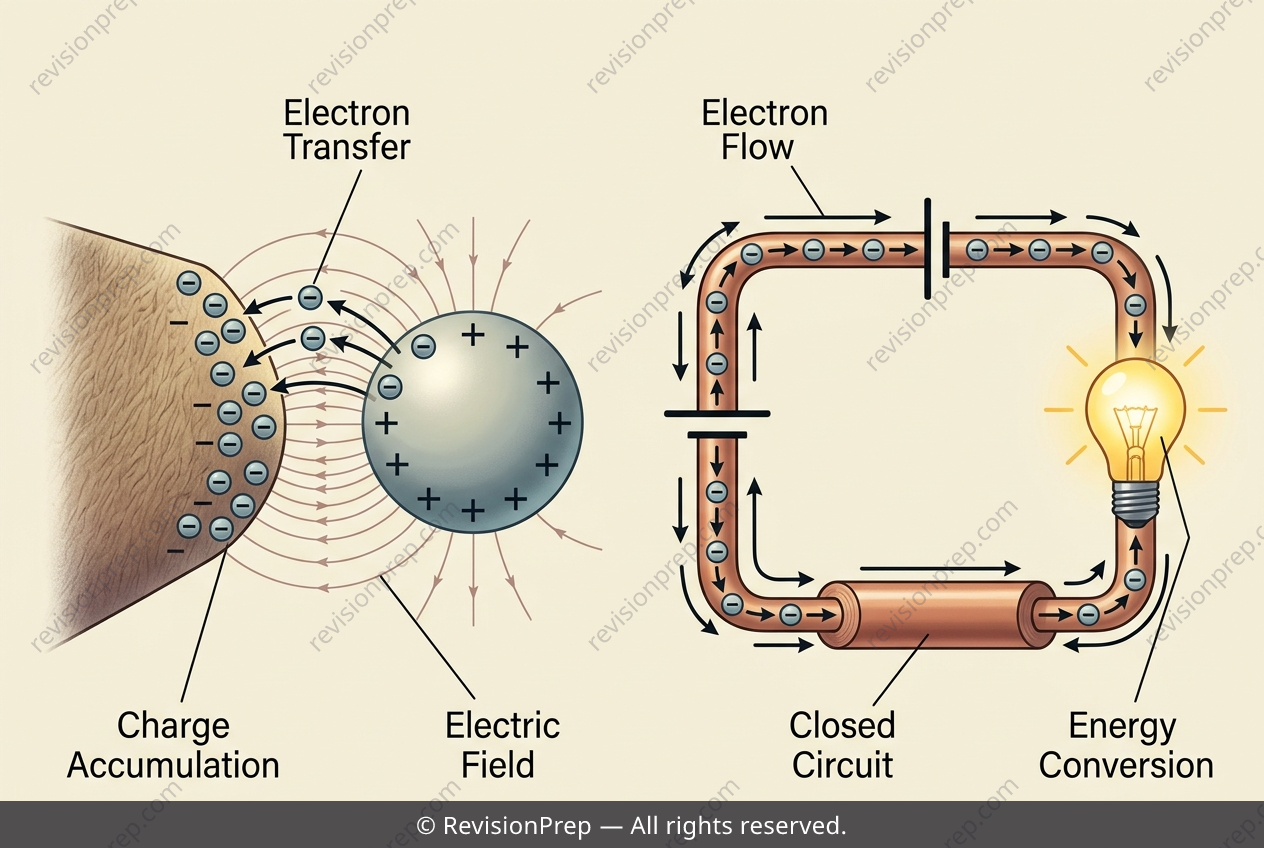
Electricity shows up in two very different ways: charge that gathers and stays put, and charge that flows in a continuous loop. Static electricity occurs when rubbing transfers electrons from one material to another, leaving one object negatively charged. That charged object can then induce an opposite charge in a nearby surface, and the resulting attraction explains effects like a balloon clinging to a wall. Here, charge builds up and remains in one place rather than moving. Current electricity is different: it requires a complete, unbroken circuit so electrons can flow continuously. A battery, wires, and bulb form a closed loop; if a gap breaks that loop, no charge moves and the bulb stays dark. Closing a switch restores the path, letting electrons travel through the filament and transfer energy as light and heat. Both situations involve electrons, but the key distinction is stationary charge versus continuously flowing charge.
Start practising IB questions today
150,000+ IB-styled questions, criteria-mapped and instantly accessible.