
Physics: Why Switches Only Turn Current On or Off
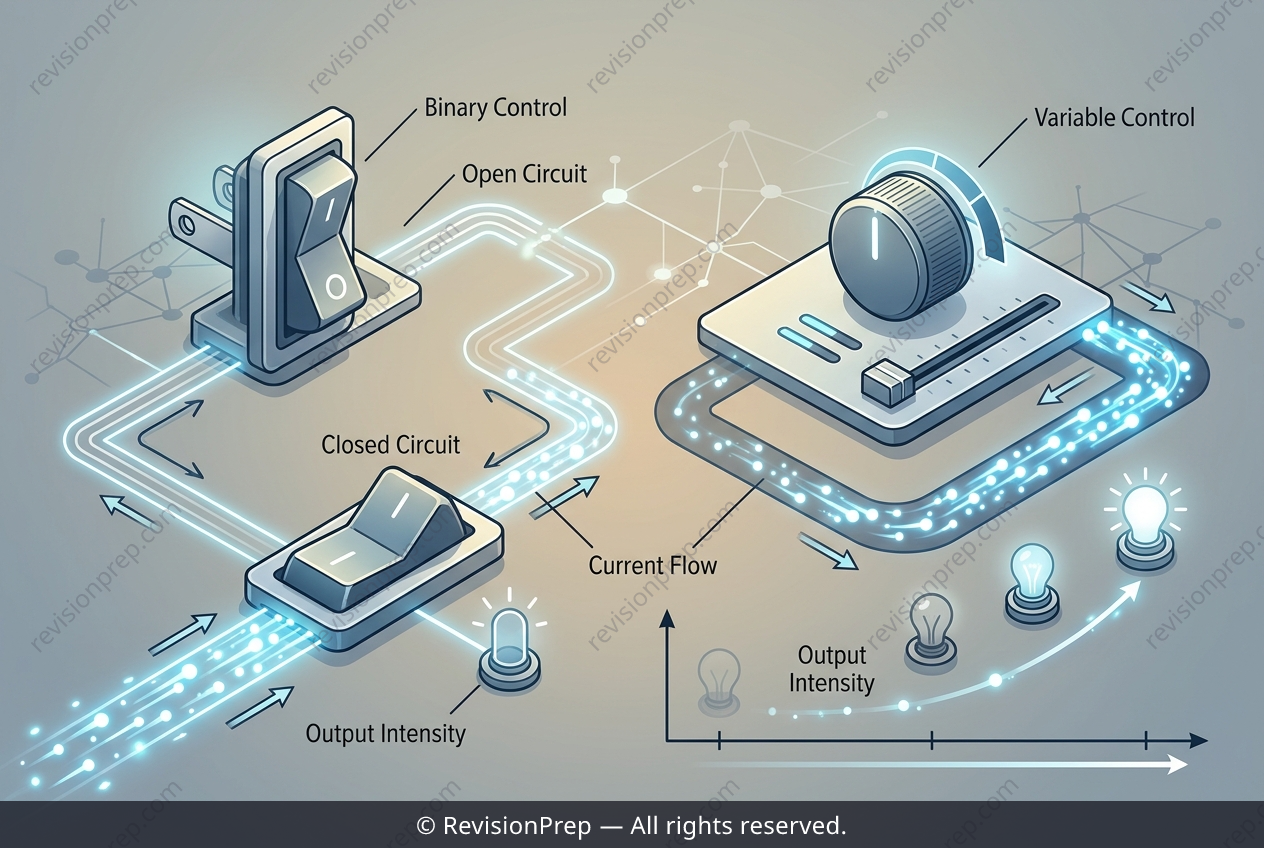
Every electrical circuit needs a complete, unbroken pathway for charge to flow. In a simple flashlight, the battery provides the potential difference that drives current, the bulb converts electrical energy into light, and the switch acts as the control element that either completes or breaks that pathway. When the switch is closed, the circuit forms a continuous loop, current flows from the battery through the bulb and back again, and the bulb lights. When the switch is open, the gap stops the current entirely, and the bulb goes dark. This on/off behaviour illustrates a key idea: current only flows in a closed circuit, and any break halts it completely. Yet a simple switch offers just two states, so it cannot regulate how much current flows. Since brightness depends on current, the bulb can only be fully on or fully off, never dimmed. Understanding this limitation shows why circuit control matters — real devices often need variable current, not just a single fixed level.
Start practising IB questions today
150,000+ IB-styled questions, criteria-mapped and instantly accessible.