
Biology: Why Cells Cannot Grow Indefinitely
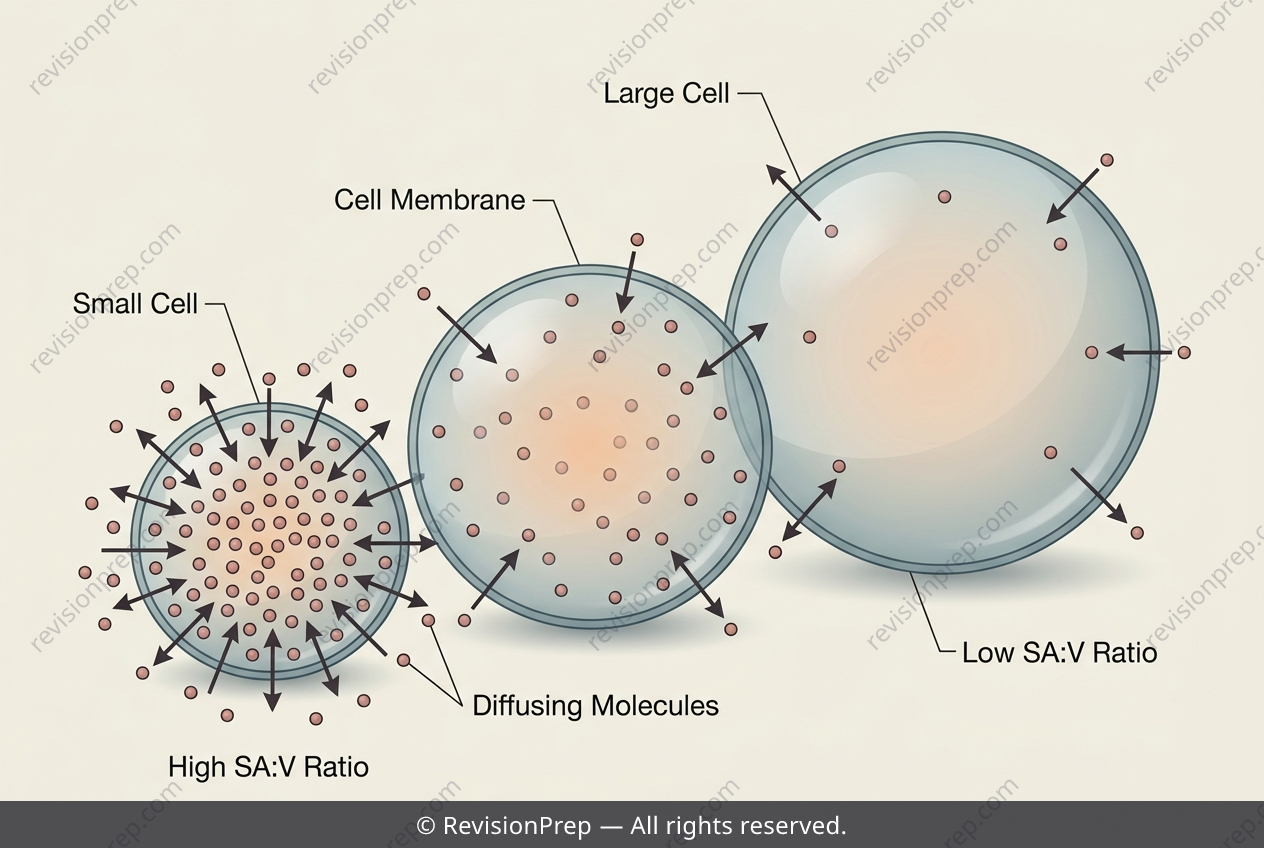
Why can a single cell never grow indefinitely? The answer lies in the surface area to volume ratio, the geometric relationship that governs how efficiently a cell exchanges materials with its surroundings. As a cell enlarges, its volume rises faster than its surface area, so the ratio of surface area to volume (SA:V) steadily falls. This matters because every molecule entering or leaving a cell must cross its surface, while the interior that consumes those molecules grows ever larger. Diffusion is the mechanism at work here. A high SA:V ratio means plenty of surface is available relative to the volume that must be supplied, so substances reach a greater proportion of the interior in a given time. The proportion coloured equals the volume of the pink layer divided by the total volume. Comparing cubes of increasing size shows the same diffusion depth penetrating a shrinking fraction of each cube, illustrating why small cells exchange substances more efficiently than large ones.
Start practising IB questions today
150,000+ IB-styled questions, criteria-mapped and instantly accessible.