
Biology: Seeing Cells Clearly Under the Microscope
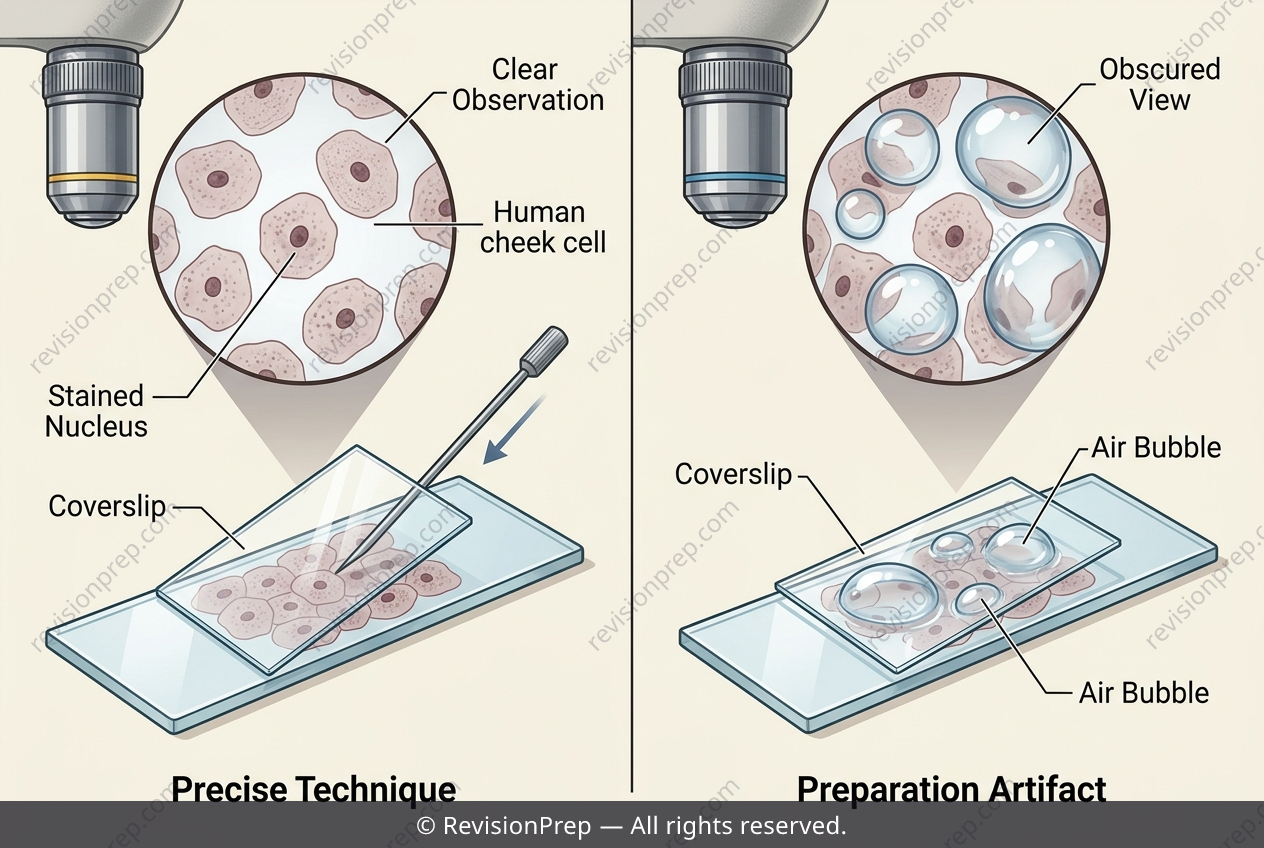
Seeing cells clearly under a light microscope depends as much on preparation technique as on the instrument itself. Human cheek cells are transparent and colourless, so without a stain such as iodine they lack the contrast needed to reveal structures like the nucleus and cytoplasm against their surroundings. Contrast, however, is only half the story. How a coverslip is lowered determines whether air becomes trapped beneath it: resting the edge at roughly 45° and lowering it slowly with a mounted needle lets air escape gradually instead of forming bubbles. Those bubbles matter because they appear as dark-edged circular artefacts that can be mistaken for cells or nuclei, and they obscure the cells beneath them, shrinking the usable area of the slide. Fewer visible cells means less evidence, and less evidence weakens the reliability of any conclusions drawn about cell structure.
Start practising IB questions today
150,000+ IB-styled questions, criteria-mapped and instantly accessible.