
Chemistry: Ammonia Toxicity vs HFC Global Warming Risk
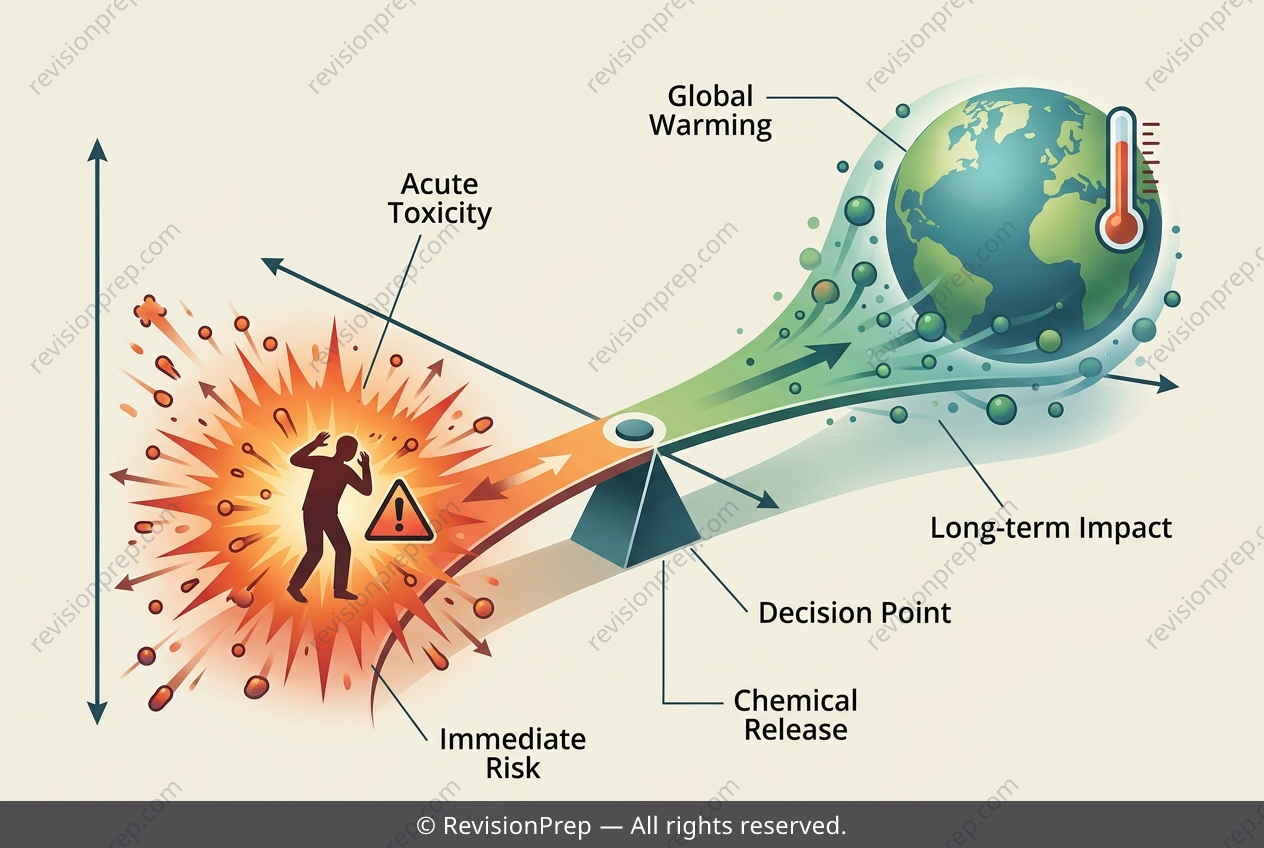
Environmental risk assessment asks us to weigh hazards that differ in kind, not just in size. A cold-storage facility choosing between ammonia and an HFC refrigerant faces exactly this: ammonia is acutely toxic, while the HFC carries a global warming potential 1000 times that of CO₂. The kinetic particle model explains why the ammonia hazard is so immediate — gas particles are in constant, random motion across a range of speeds, so a leak produces diffusion, a net movement from high to low concentration. Rapid motion and collisions with air particles spread the gas in all directions, quickly reaching a wide area. The two risks then diverge in time scale, geography, and who is affected. Acute toxicity is a short-term, localised danger, manageable through engineering controls such as leak detectors and emergency shutdowns. HFC release poses little immediate harm but contributes to climate change over decades, with consequences like sea-level rise and extreme weather. Evaluating the trade-off means comparing these fundamentally different harms rather than assuming one option is simply safer.
Start practising IB questions today
150,000+ IB-styled questions, criteria-mapped and instantly accessible.