
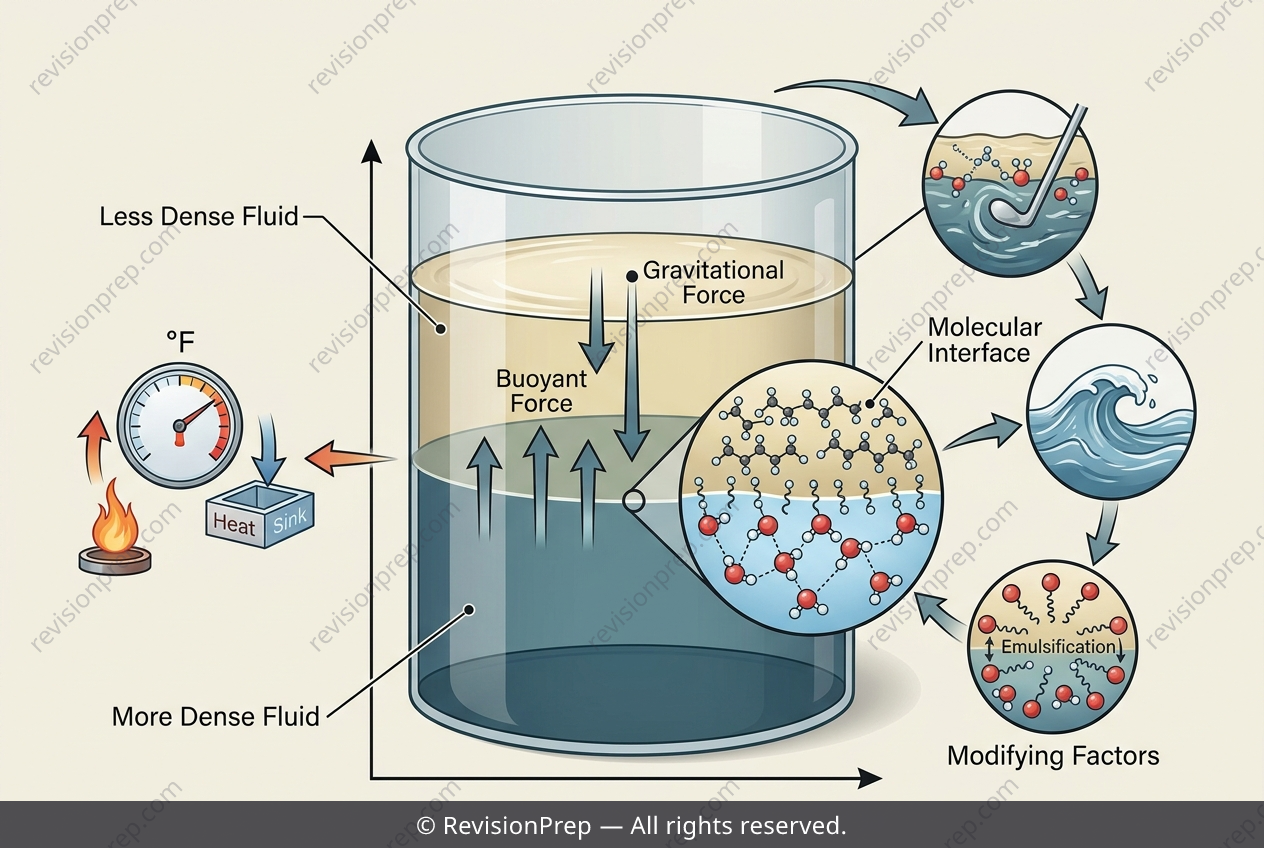
Chemistry: Density, Buoyancy and Oil Emulsification
Density differences govern how fluids arrange themselves, and nowhere is this more dramatic than when crude oil (density ≈ 850 kg m⁻³) meets seawater (density ≈ 1025 kg m⁻³). Because the oil is less dense, it floats, spreading into a continuous surface slick — as seen across thousands of square kilometres during the 2010 Deepwater Horizon spill. This single comparison, ρ(oil) < ρ(seawater), explains both buoyancy and the environmental consequences that follow. That floating film matters because it blocks sunlight from reaching phytoplankton and seagrasses, disrupting photosynthesis and the oxygen production marine food webs depend on. Yet density difference alone assumes oil stays pure and unchanged at the surface. In reality, wave action and turbulence emulsify oil with seawater, forming a denser water-in-oil mixture whose increased effective density can drag portions below the surface — behaviour a simple density comparison cannot predict.
Start practising IB questions today
150,000+ IB-styled questions, criteria-mapped and instantly accessible.