
Chemistry: How Particle Arrangement Shapes Matter
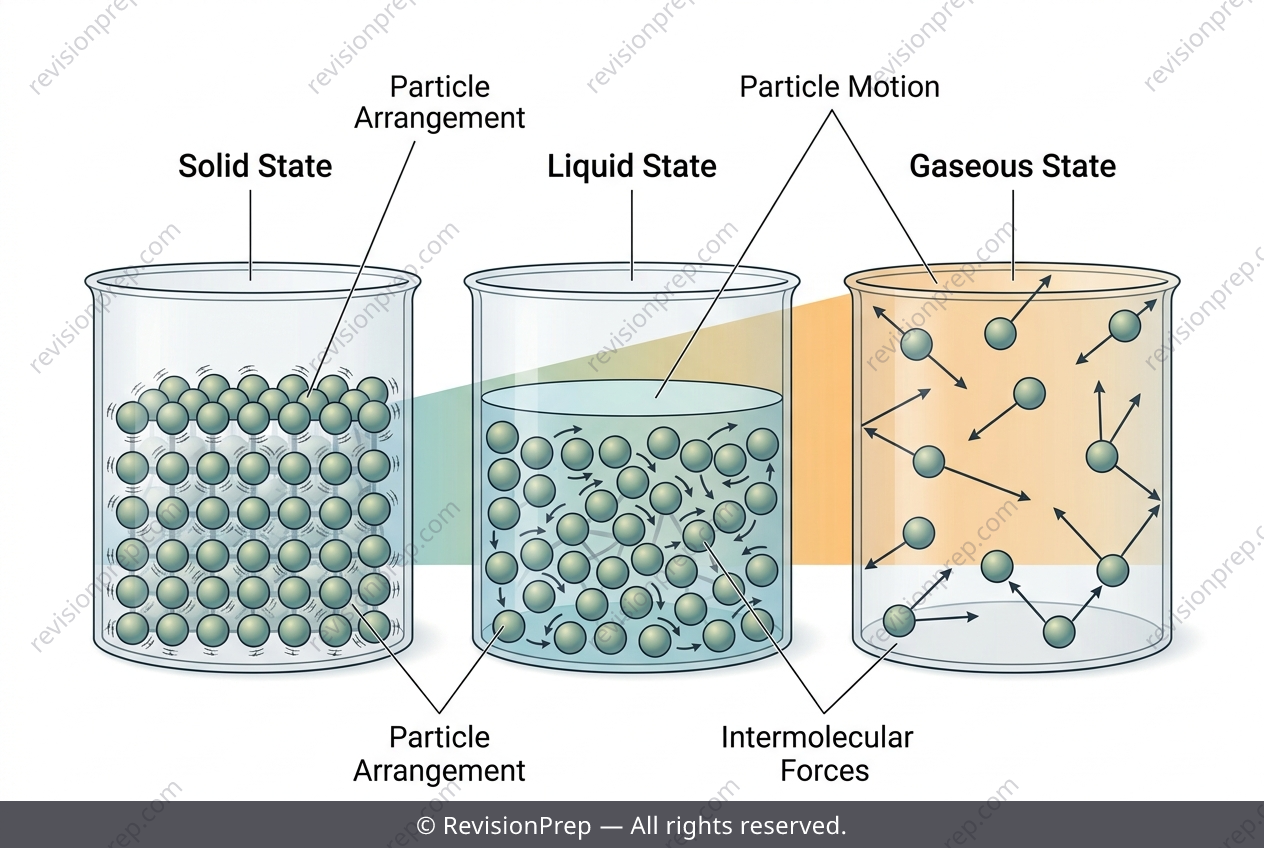
The kinetic particle theory explains the behaviour of matter by describing how particles are arranged and how they move. In solids, particles sit in a regular, repeating lattice with fixed positions, vibrating about a point. In liquids, particles remain closely packed but are randomly arranged, free to slide past one another. In gases, particles are widely spaced with large gaps, moving rapidly and randomly in all directions. These differences in spacing and motion account for the observable properties of each state. Because liquid particles are close together with little empty space, they resist compression, yet their freedom to move past each other lets them flow. Gas particles, held by negligible attractive forces, spread out to occupy any available volume. Recognising how arrangement connects to behaviour — from fixed lattices to free-flying particles — is central to understanding changes of state and the physical properties of matter.
Start practising IB questions today
150,000+ IB-styled questions, criteria-mapped and instantly accessible.