
Chemistry: How New Substances Form Without Losing Mass
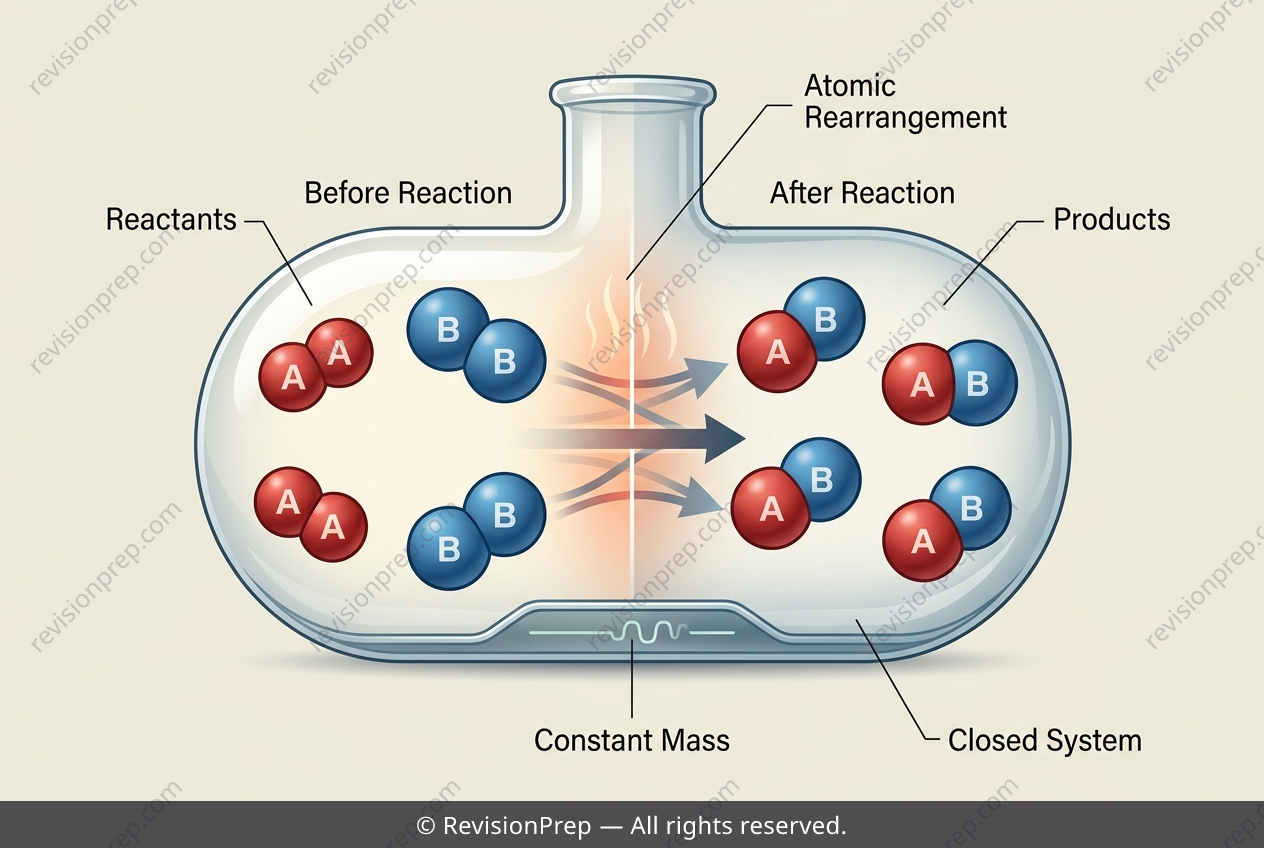
Chemical changes are at the heart of chemistry: reactants transform into entirely new substances with different properties. When iron (Fe) and sulfur (S) are heated together, they react to form iron sulfide (FeS), a compound unlike either starting element. Graphically, this appears as two decreasing lines — the reactants being used up — and one increasing line representing the product being formed. That increasing line is the key signal that something new has been created. This matters because it connects directly to the law of conservation of mass. Throughout the reaction, the total mass of the system stays constant, because no atoms are created or destroyed — the same atoms are simply rearranged. The Fe and S atoms reorganise into FeS, and the original substances cannot be recovered by physical means. Recognising that a new substance with different chemical properties has formed, while mass remains unchanged, is what distinguishes a chemical change from a physical one.
Start practising IB questions today
150,000+ IB-styled questions, criteria-mapped and instantly accessible.