
Chemistry: How Particle Size Determines Diffusion Rate
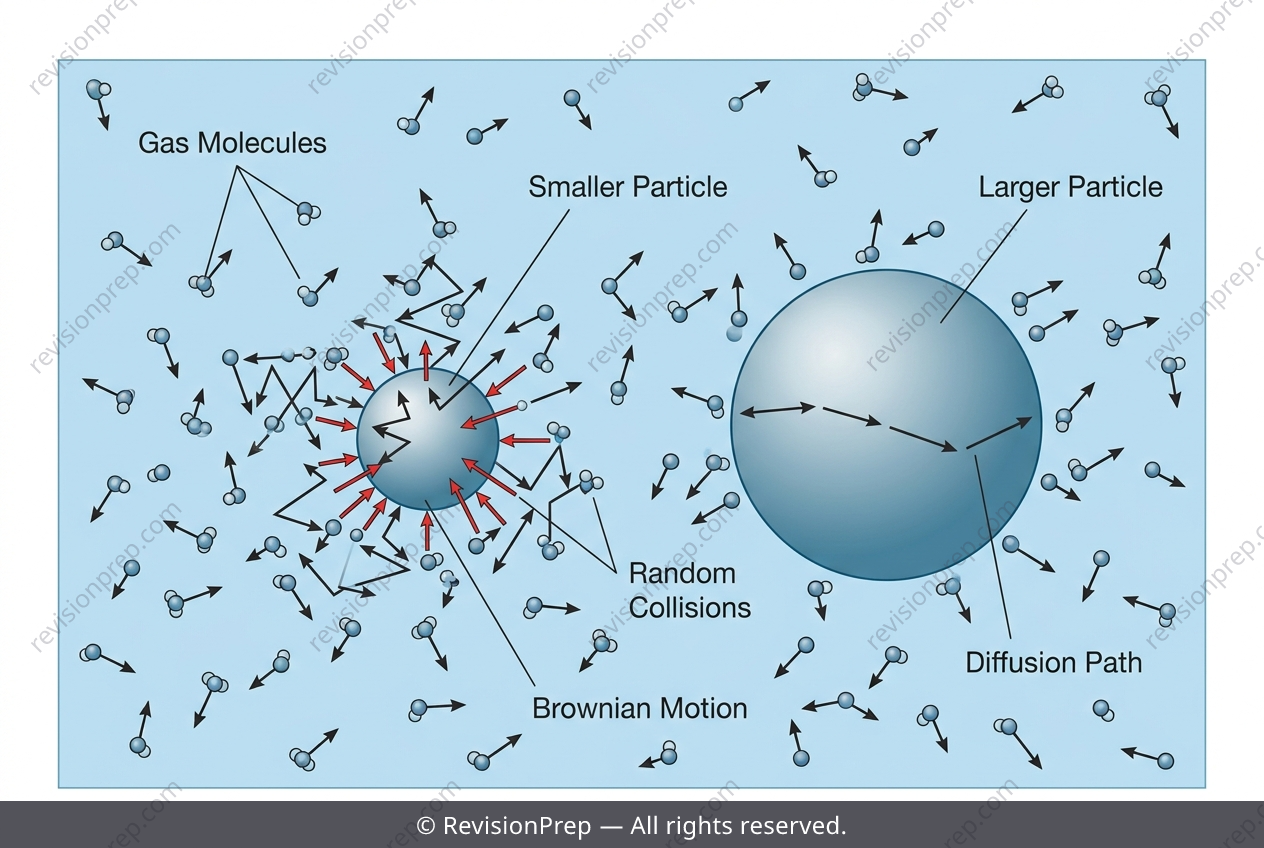
Brownian motion describes the erratic, zigzag movement of tiny particles suspended in a fluid, caused by unbalanced molecular collisions. Air molecules such as N2 and O2 move randomly at high speeds, striking particles from all directions; for very small particles, these impacts never perfectly cancel, producing a net random force. This ceaseless jostling counteracts gravitational settling, allowing ultrafine particulates like PM2.5 to remain airborne and penetrate deep into lung tissue. The Stokes–Einstein relation connects this motion to particle size: D ∝ 1/r, so smaller particles diffuse faster. Comparing PM2.5 and PM10 means halving their diameters to find radii, then taking the ratio of diffusion coefficients. Real conditions add complexity — in the humid respiratory tract, water vapour may condense onto particles or interact via intermolecular forces, altering their effective mass and radius. Together, these ideas link molecular collisions, particle size, and diffusion behaviour.
Start practising IB questions today
150,000+ IB-styled questions, criteria-mapped and instantly accessible.