
Chemistry: How Solute Mass Relates to Solution Volume
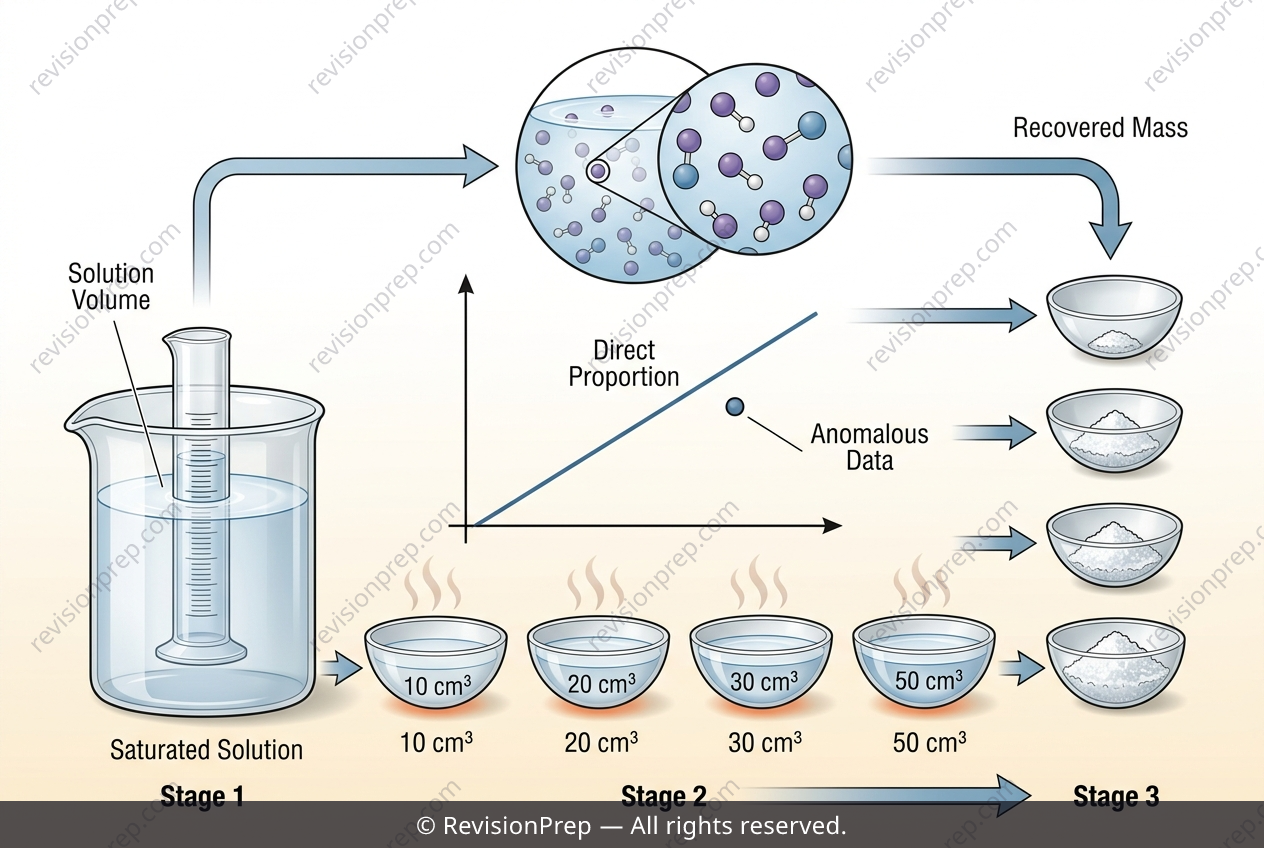
Quantitative relationships in solutions describe how the amount of dissolved solute scales with the volume of solution. For a saturated solution at a fixed temperature, concentration is uniform throughout, so mass and volume stay in a constant ratio: concentration = mass ÷ volume. This proportionality is the foundation for predicting how much solid remains after evaporation or crystallisation. Understanding this matters because it links everyday separation techniques to measurable, predictable quantities. When evaporation is complete, the recovered solid reflects the solute present in that volume, so doubling the volume doubles the mass, tripling triples it, and so on. Plotting mass against volume should therefore give a straight line through the origin. Real data rarely behave perfectly. One inconsistent point can break the trend, often through incomplete evaporation or loss of solid during transfer. Identifying such anomalies, and explaining them using the expected proportional relationship, is central to analysing solutions quantitatively.
Start practising IB questions today
150,000+ IB-styled questions, criteria-mapped and instantly accessible.