
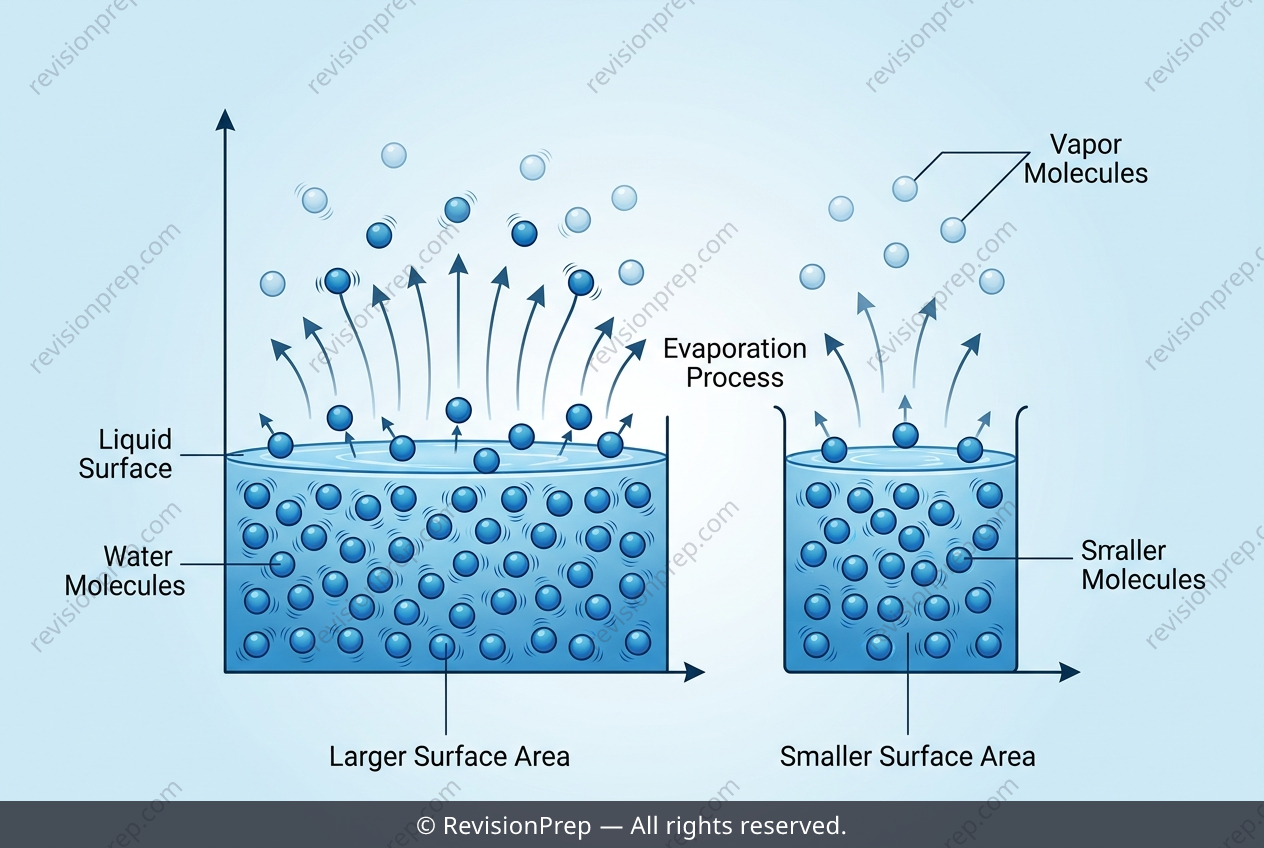
Chemistry: How Surface Area Controls Evaporation Rate
Evaporation is the process by which liquid particles at a surface gain enough energy to escape into the surrounding air as a gas. Its rate depends on several factors, including temperature, humidity, airflow, and — crucially here — the surface area of the liquid exposed to the atmosphere. A larger exposed surface allows more molecules to escape per unit time, so the volume of liquid falls more quickly, producing a steeper gradient on a volume–time graph. This matters because evaporation underpins separation techniques such as crystallization and is central to understanding how physical conditions control the speed of change. When two identical liquids are left under the same conditions, any difference in their evaporation rates must come from a variable that actually differs between them. Since temperature is held constant, surface area becomes the deciding factor: the wider the container, the greater the exposure, and the faster the volume decreases.
Start practising IB questions today
150,000+ IB-styled questions, criteria-mapped and instantly accessible.