
Chemistry: How the Tyndall Effect Classifies Mixtures
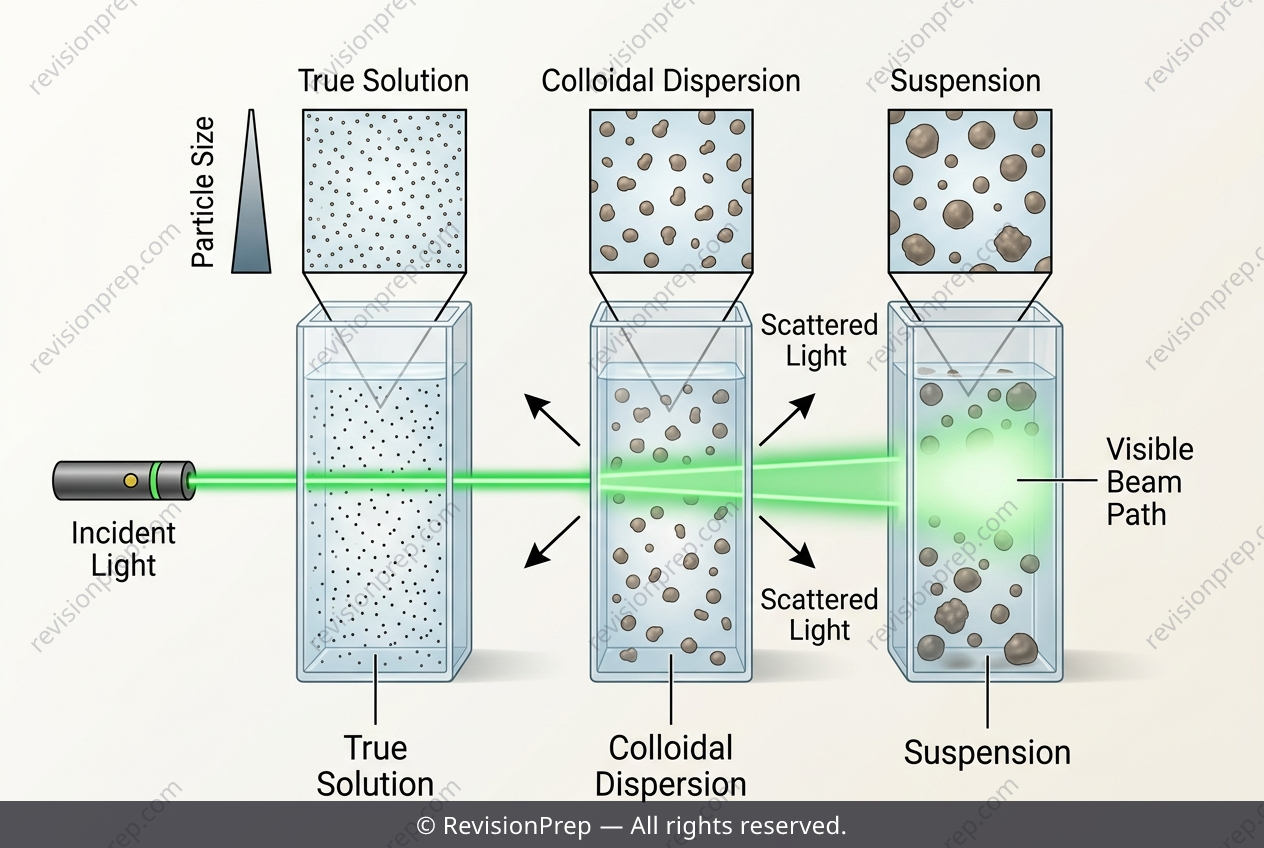
The Tyndall effect is the sideways scattering of light by particles dispersed in a medium, and it sits at the heart of how chemists classify mixtures by particle size. In a true solution, solute particles are typically below 1 nm — too small to scatter visible light, so a laser beam passing through remains invisible. Colloidal particles, roughly 1–1000 nm, are large enough to redirect light sideways, producing a visible beam path. Suspensions are larger still and eventually settle. This distinction matters because it links particle size to observable behaviour, letting a single beam of light reveal what is happening at a scale far below the eye. The mechanism is straightforward: scattering intensity depends on particle size and concentration, so fewer or smaller particles scatter less light. That relationship also exposes the limits of the test — a very dilute colloid may scatter too weakly to see, mimicking a true solution, while observer judgement and ambient lighting add further uncertainty.
Start practising IB questions today
150,000+ IB-styled questions, criteria-mapped and instantly accessible.