
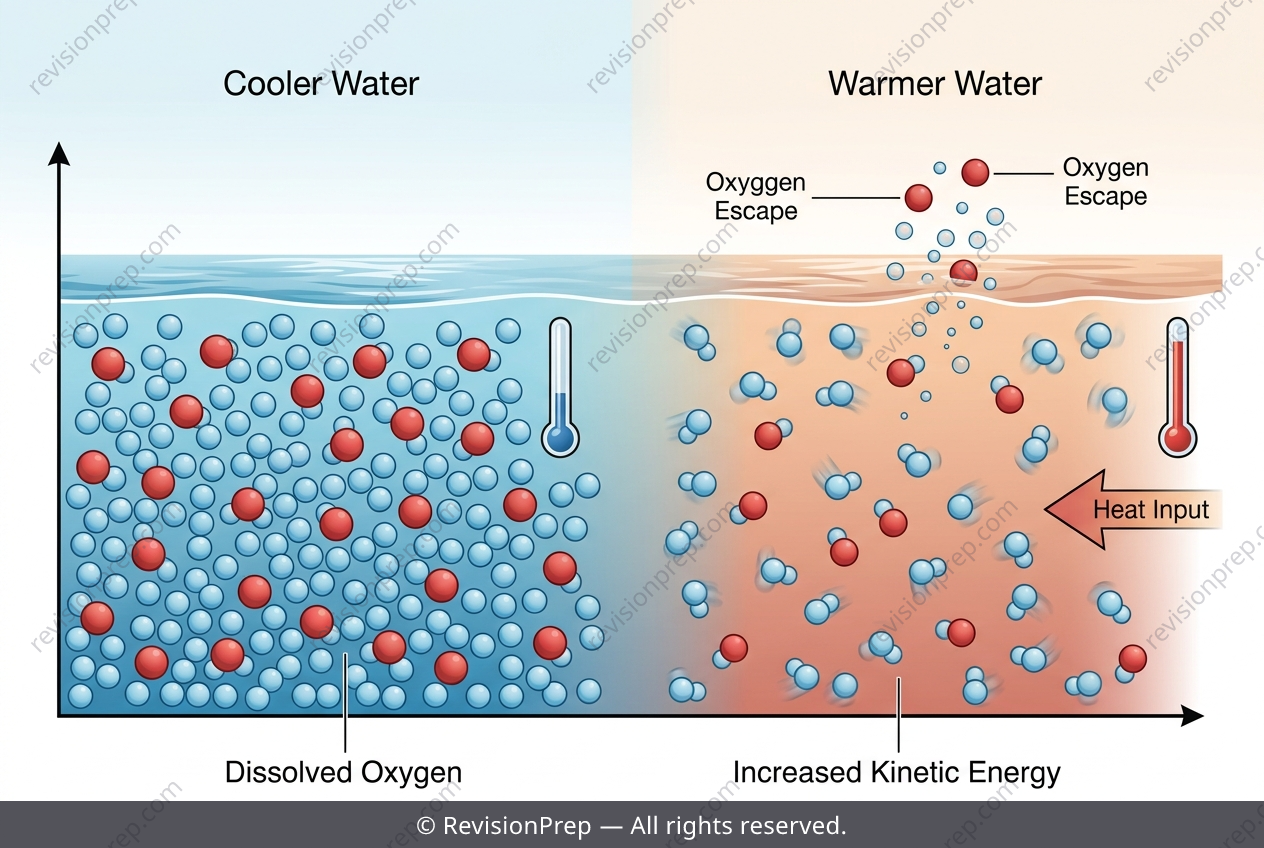
Chemistry: How Temperature Affects Gas Solubility
Dissolved gases behave very differently from solid solutes when water warms up. While most solids become more soluble at higher temperatures, gases become less soluble — a direct consequence of the fact that dissolution is exothermic for gases, so added heat shifts the equilibrium back towards the gaseous state. In practical terms, the concentration of dissolved oxygen in a river is inversely related to its temperature: as thermal energy increases, oxygen molecules escape the liquid more readily, and the water simply cannot hold as much of it. This relationship matters enormously in aquatic ecosystems, where dissolved oxygen is the currency of survival. Fish and other organisms depend on it for cellular respiration, so any sustained rise in water temperature steadily erodes the oxygen supply they rely on. When a power plant discharges warm water into a river, that seemingly small thermal increase can push oxygen levels below the threshold needed to sustain life, creating hypoxic conditions that ripple outward through the entire food web.
Start practising IB questions today
150,000+ IB-styled questions, criteria-mapped and instantly accessible.