
Maths: Why a Weight Error Shifts a Child's Dose
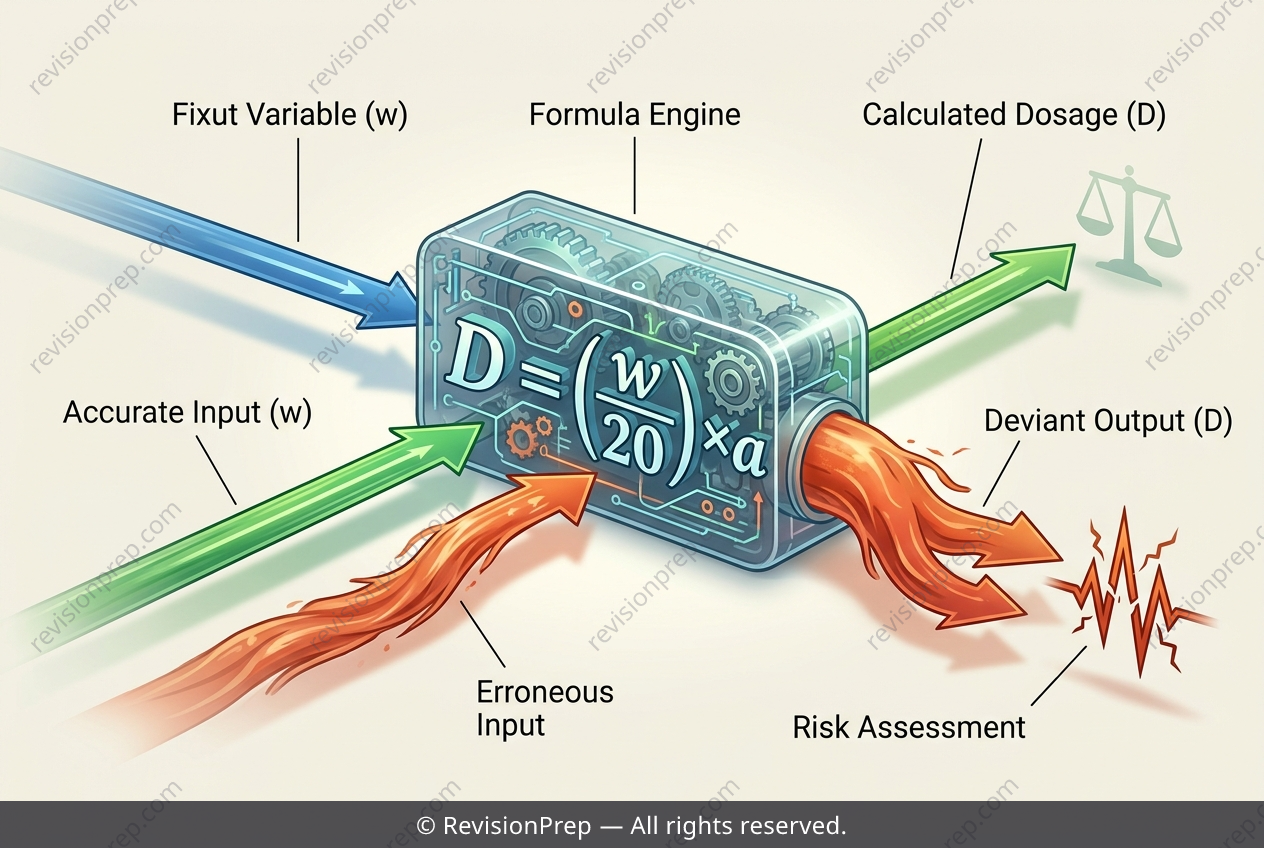
Medication dosing for children is rarely a simple fixed number; it scales with the patient. The formula D = (w ÷ 20) × a captures this, linking dosage D in mg to a child's weight w in kg and the adult dosage a in mg. Because w sits in the numerator, D is directly proportional to weight: any proportional change in w produces the same proportional change in D. This relationship is the heart of the topic, showing how a single substituted value flows through the formula to determine the outcome. Understanding this matters because input values are not always accurate. A weight recorded incorrectly, even by a few kilograms, shifts the calculated dosage by the same percentage. Comparing a correct substitution with an erroneous one reveals the size of that shift, exposing whether the resulting dose stays safe or becomes clinically risky. Recognising the direct proportionality between weight and dosage is what turns a routine calculation into a meaningful judgement about patient safety.
Start practising IB questions today
150,000+ IB-styled questions, criteria-mapped and instantly accessible.