
Physics: Newton's Laws and Net Force in Motion
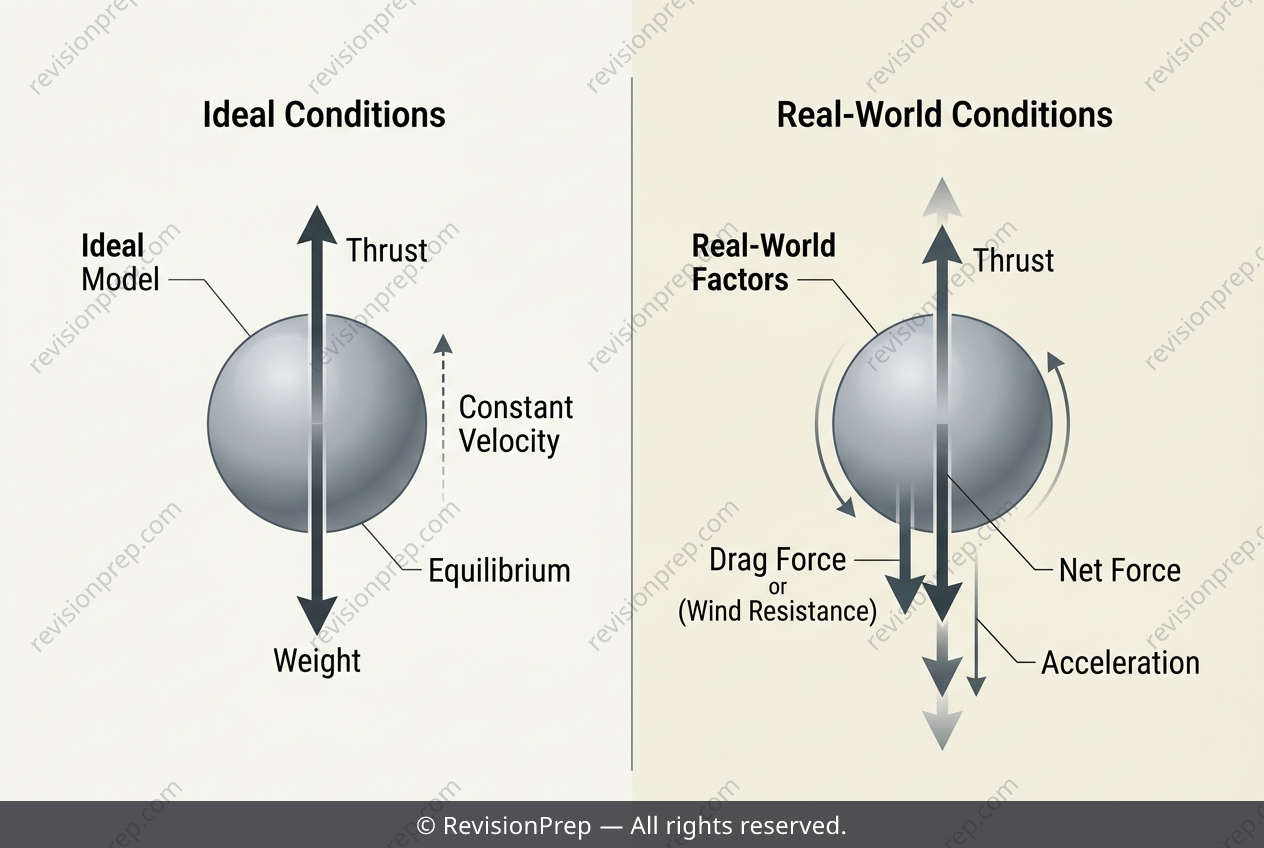
Newton's Laws of Motion describe how the net force acting on an object determines whether its velocity changes. When the forces on a body are balanced, the net force is zero and the object moves at constant velocity; when they are unbalanced, a resultant force produces acceleration in the direction of that force. This distinction underpins countless real-world situations, from a drone hovering in place to a rocket climbing through the atmosphere. The key relationship is Fnet = ma: acceleration depends directly on the vector sum of all forces and inversely on mass. Weight, given by W = mg, is one such force, while thrust, drag, and other contact forces complete the picture. In an idealised model, equilibrium (Fnet = 0) lets us equate opposing forces and predict motion simply. In reality, forces such as wind resistance and varying motor output shift over time, so the net force is rarely perfectly balanced, making constant-velocity assumptions only an approximation of actual behaviour.
Start practising IB questions today
150,000+ IB-styled questions, criteria-mapped and instantly accessible.